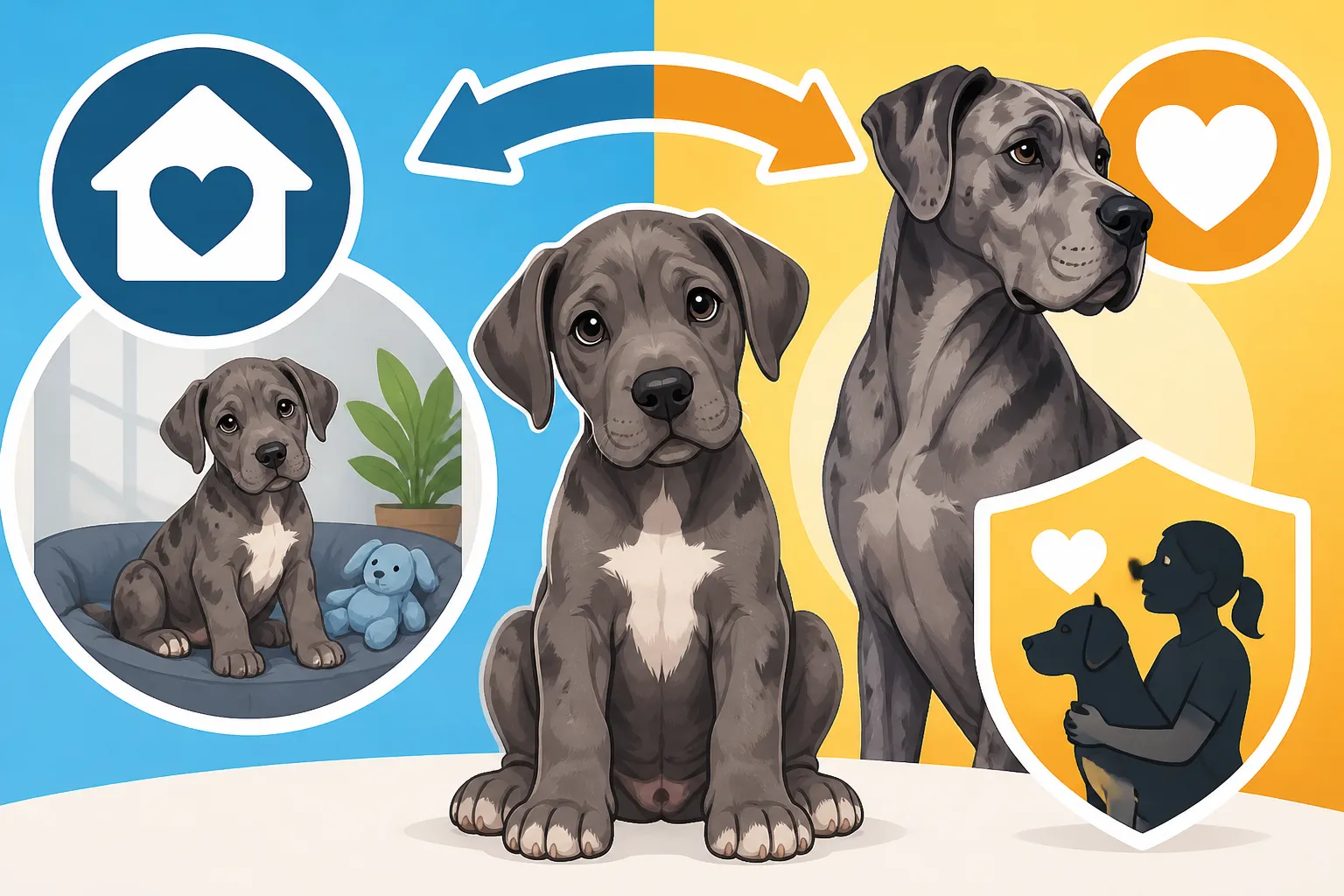
Whether a Great Dane Puppy Should Stay Until Ten Weeks
A Great Dane puppy may be ready to leave at eight weeks, but that does not mean every puppy should go home then—or that ten weeks is automatically better. The important question is what the breeder is doing during those extra weeks: supporting health, gentle handling, and age-appropriate socialization, rather than simply waiting for a date on the calendar.
Is ten weeks too late for a Great Dane puppy to come home
For a healthy, well-cared-for puppy, going home at ten weeks can be perfectly reasonable. Many puppies leave their litter around eight weeks, while some responsible breeders keep them longer to continue their care and early learning. The number alone does not tell you whether the timing is right.
What matters is whether the puppy is thriving with the breeder, has suitable contact with its mother and littermates, and is being gradually introduced to ordinary sights, sounds, surfaces, and gentle handling. Those experiences are part of the puppy’s start in life, not a substitute for the relationship you will build once it comes home.
Why breeders may keep a puppy until ten weeks
A breeder may keep a puppy beyond eight weeks to monitor its health, help it become comfortable with handling, or give it more time to learn alongside its littermates. For a Great Dane, that early foundation can be useful: this small puppy will grow into a very large dog, so being comfortable with people, everyday noises, and cooperative care is worth building from the start.
A thoughtful breeder should be able to explain what the puppy is learning during the extra time. That might include short, calm experiences such as walking on different safe surfaces, hearing household sounds at a comfortable volume, being gently examined, or meeting a few suitable people. The goal is not to overwhelm the puppy with constant activity; it is to make new experiences manageable and positive.
Keeping a puppy longer is not automatically a sign of better breeding, though. If the puppy spends those extra weeks with little human contact, little change in its surroundings, or no chance to explore safely, the calendar date does not make up for that. Ask about the puppy’s daily routine and the breeder’s approach to early socialization. For more ideas on what to ask, see Questions to Ask Before Taking a Great Dane.
What matters more than the exact pickup week
The puppy’s overall wellbeing is more useful to assess than whether it is exactly eight, nine, or ten weeks old. Ask whether it is eating and growing appropriately, appears alert and comfortable, and has been examined by a veterinarian. Request the puppy’s records and ask what care, vaccinations, and parasite prevention have been provided so far.
It is also reasonable to ask how the breeder is preparing the litter for the transition. Has the puppy spent time away from its mother and littermates for short periods? Has it encountered household sounds, different flooring, or gentle grooming and handling? A puppy that has had calm, age-appropriate practice may find the move to a new home easier than one whose world has been very limited.
A breeder should welcome practical questions instead of treating them as an insult. If you are also evaluating the parents and the puppy’s background, Seeing the Dam Before Buying a Great Dane and Reading a Great Dane Puppy's Health Papers can help you make a more informed decision.
Why puppies need time with their mother and littermates
Puppies learn from one another as well as from people. Early play, pauses, and interactions with littermates give them opportunities to develop social skills, while their mother’s presence can provide familiarity and structure. That does not mean a puppy must stay with its litter as long as possible. It means the transition should happen at an appropriate age and with the puppy’s welfare in mind.
Taking a puppy too early can remove it from those experiences before it is ready. At the same time, a puppy that remains with its litter should still be receiving attentive human care and safe exposure to the world beyond the whelping area.
What a puppy can learn in the litter
During play, puppies get feedback from one another. If one puppy is too rough, a littermate may stop playing or move away. These ordinary interactions can help a puppy learn to adjust its behavior. People still need to teach and reinforce appropriate manners after the puppy comes home, but litter experience can be one part of early social development.
Puppies also begin to encounter different sights, sounds, and handling experiences during this period. A breeder can introduce these gently, keeping sessions short and watching for signs that a puppy is worried or overwhelmed. For example, a puppy might explore a new surface at its own pace rather than being placed on it and held there.
The quality of these experiences matters. Busy exposure without a chance to retreat can frighten a puppy, while calm, gradual introductions can help it build confidence. The same principle applies when you continue socialization at home. Socializing a Great Dane Puppy Early explores how to introduce new experiences without turning them into a stressful checklist.
Why very early separation can be a concern
A puppy that leaves its mother and littermates too young may miss opportunities for social learning and may find the transition more difficult. The exact effects vary from puppy to puppy, but early separation is a reason to ask careful questions rather than assume that a younger puppy will simply “catch up” once it arrives.
Do not let convenience or pressure rush the decision. If a breeder wants you to take a puppy unusually early, ask why, and discuss the situation with a veterinarian or a knowledgeable, reputable breed professional. Requirements about the minimum age at which a puppy can be sold or transferred vary by location, so check the rules that apply where you live.
A puppy’s readiness also involves more than being able to eat solid food or walk around. It should be old enough for an appropriate transition and supported by a breeder who can explain its care and development. When comparing breeders, Why the First Four Months Decide a Great Dane offers useful context for why early experiences deserve attention.
Comparing an eight-week and ten-week pickup
There is no single pickup week that is right for every Great Dane puppy. Use the comparison below as a starting point for a conversation with the breeder, not as a pass-or-fail scorecard.
| Timing | Potential advantages | Questions to ask |
|---|---|---|
| Around eight weeks | The puppy can begin bonding with its new household while still young and adaptable | Is the puppy eating well, medically assessed, and ready for the transition? What social experiences has it had? |
| Around nine weeks | The breeder has a little more time to observe the puppy and support early learning | What is the puppy doing during this extra week? Is it getting positive human contact and safe new experiences? |
| Around ten weeks | The puppy may have additional time with its litter and breeder-led handling or socialization | Is the puppy thriving in the breeder’s care? How is the breeder preparing it for a new home? |
| Later than ten weeks | A later move may suit an individual puppy or a specific care plan | What is the reason for the later placement, and how will the puppy continue to be socialized? |
When an eight-week pickup may make sense
An eight-week pickup may be appropriate when the puppy is healthy, the breeder has provided suitable care, and the puppy is ready to leave. You should be able to get a clear handover: records, feeding guidance, information about the puppy’s routine, and a plan for follow-up veterinary care.
The breeder’s transition support matters here. Ask what food the puppy currently eats, how meals are scheduled, where it sleeps, and what the breeder recommends for the first few days. Changing food and routines all at once can make an already-big change harder for a young puppy. If you are buying supplies in advance, check dimensions carefully; items marketed for “puppies” may not suit a rapidly growing Great Dane for long. Retailers such as Chewy can be one place to compare product measurements for gates, washable mats, and feeding supplies.
When waiting until ten weeks may make sense
Waiting until ten weeks may be a good fit if the breeder is using the time well and the puppy remains comfortable and healthy. It can also give the breeder more time to learn about each puppy’s temperament and share useful observations with the new family. A little insight into whether a puppy is bold, cautious, energetic, or more reserved can help you plan a gentler first week.
Ask for specific examples of the puppy’s routine. “We’re socializing them” is less informative than hearing that puppies have had gentle handling, short periods of individual attention, and safe exposure to everyday household sounds. Check whether the puppy still has access to rest and familiar company rather than being pushed through a parade of visitors.
A longer stay should not mean postponing your own preparation. Set up a calm sleeping area, plan how you will manage toileting, and arrange a veterinary visit after the puppy comes home. If you are shopping for a crate or pen, compare the usable dimensions and safety details rather than choosing by a product label alone. Chewy and other pet retailers may list measurements, but your puppy’s current size and likely growth should guide what you buy.
How to decide whether the timing is right for your puppy
Think of the decision as a conversation about the individual puppy, not a debate over whether eight or ten weeks is universally best. Ask the breeder to describe the puppy’s health, routine, experiences, and readiness to move. Then make sure you have a practical plan for the first days at home.
Questions to ask the breeder before pickup
Ask what the puppy eats and how much it is currently offered, how it sleeps, and how often it is taken out to eliminate. Find out whether the puppy has been examined by a veterinarian and request copies of relevant records. Ask what the breeder has observed about the puppy’s behavior and how it responds to handling or unfamiliar sounds.
You can also ask what the breeder plans to do if the puppy seems unsettled when the pickup date arrives. A responsible breeder should be willing to discuss the puppy’s needs and may recommend a different plan if there is a health or welfare concern. Likewise, if you have concerns about the puppy’s condition, do not rely on reassurance alone; seek veterinary advice.
It can help to ask for a written transition plan covering food, sleep, toilet routines, and the next steps for veterinary care. The more familiar the first few days feel, the easier it may be for both puppy and household to settle. For related preparation, Getting a Great Dane Puppy Used to Handling can help you think about gentle, positive care routines after arrival.
Preparing for the first week at home
Keep the first few days low-key. A puppy may be curious and lively one moment, then tired or unsure the next. Give it a quiet place to rest, supervise interactions with children and other pets, and introduce the home gradually. Avoid inviting a stream of visitors simply because everyone wants to meet the new puppy.
Follow the breeder’s feeding guidance at first, then ask your veterinarian before making changes. Great Dane puppies have specific growth and nutrition considerations, so avoid adding supplements or changing to a different food based on casual advice. Why Calcium Supplements Damage a Great Dane and Why a Great Dane Puppy Should Grow Slowly explain why giant-breed puppy care deserves thoughtful attention.
Plan gentle, positive introductions to people, household sounds, surfaces, and handling. Socialization does not mean taking a young puppy everywhere or letting every stranger touch it. It means helping the puppy experience the world safely, at a pace it can manage. Keep supplies accessible but do not overbuy equipment the puppy may outgrow quickly. Chewy can be useful for comparing options such as washable floor coverings or storage containers; check measurements and material details before choosing.
If the puppy comes home at ten weeks, the same basics apply. If it comes home at eight weeks, they apply just as much. The pickup date is only one part of the puppy’s start. Good preparation, a reliable breeder, veterinary guidance, and steady, kind socialization continue to matter after the puppy crosses your front door.
Disclaimer
This article is for general informational purposes only and does not constitute professional advice. Laws, prices and regulations vary by location and change over time. Consult a qualified professional for guidance on your specific situation.