Choosing Foam Thick Enough for a Great Dane
One of the biggest struggles Great Dane owners face, especially as their magnificent companions grow, is finding a dog bed that actually provides the support and comfort their immense size demands. You’ve probably seen countless beds flatten into pancakes under your Dane’s weight, offering no real cushioning and potentially leading to discomfort or even exacerbating joint issues. This guide will walk you through exactly what to look for when choosing foam for a Great Dane bed, ensuring your gentle giant gets the restorative rest they truly need.
Understanding Your Great Dane's Unique Needs for Support
It's easy to think "any dog bed will do," but for a Great Dane, that couldn't be further from the truth. Their sheer size and weight put them in a league of their own when it comes to bedding requirements. Neglecting these needs can have real, long-term consequences for their health and comfort.
The Impact of Size and Weight on Joint Health
Let's be honest, our Great Danes are big. Really big. A healthy adult male can easily tip the scales at 140 to 175 pounds, sometimes even more, and stand over 30 inches tall at the shoulder. Imagine that much weight pressing down on joints for hours on end, night after night. This constant pressure, especially on hard surfaces, is a recipe for trouble. Their elbows, hips, and shoulders bear the brunt of it, and over time, inadequate support can contribute to or worsen conditions like arthritis, hip and elbow dysplasia, and general joint pain.
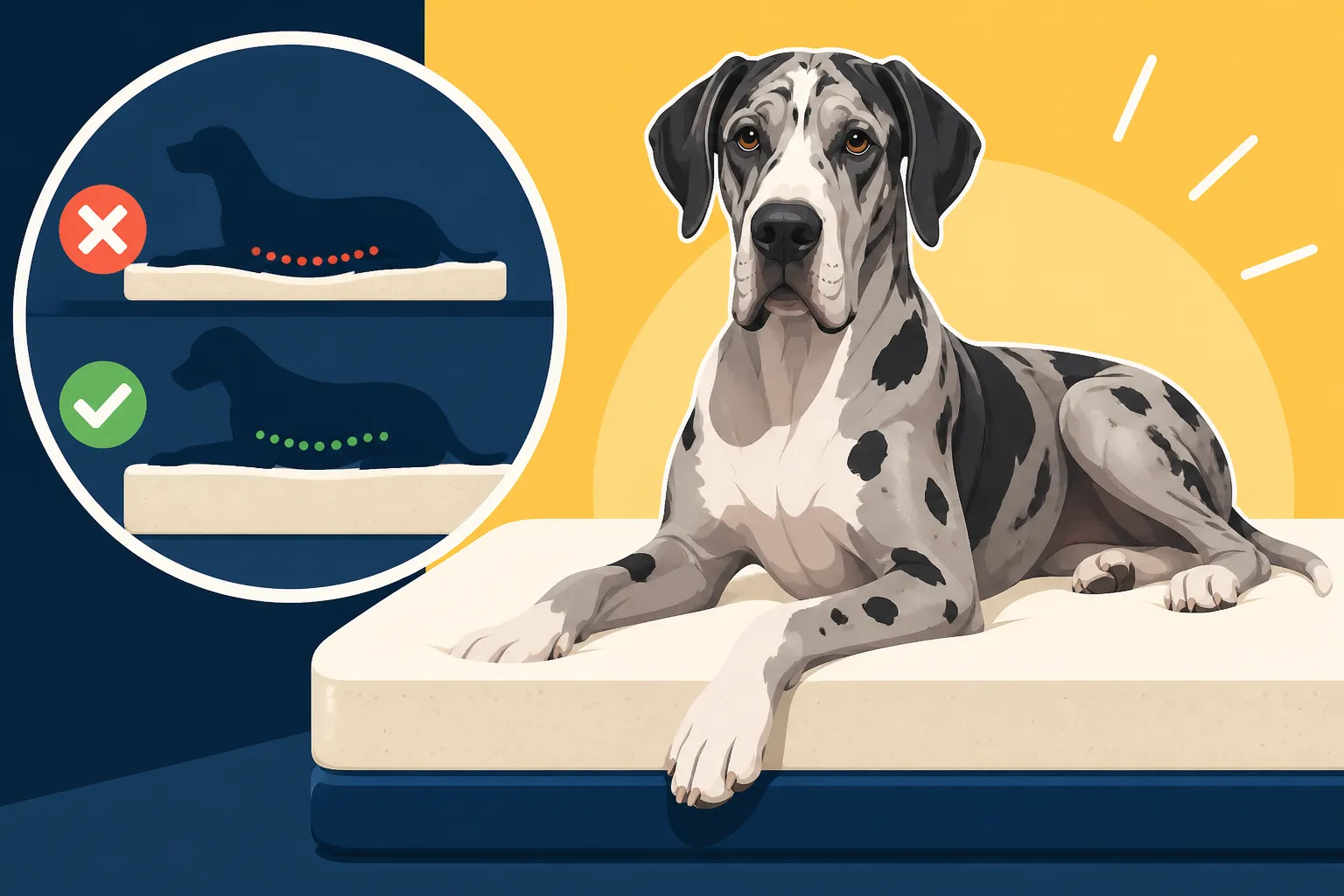
Think about it from your own perspective. Would you want to sleep on a thin, worn-out mattress that lets your body sink straight to the floor? Of course not! Your Great Dane feels the same way. Proper, thick foam cushioning acts like a shock absorber, distributing their weight evenly and relieving pressure points. This is incredibly important for maintaining healthy mobility as they age and is a key part of preventing issues that often plague large breeds. We talk a lot about Great Dane Hips, Elbows and Growing Joints in our community, and believe me, a good bed is foundational to supporting those critical areas.
Why Standard Dog Beds Just Don't Cut It
You've probably experienced the frustration of buying a "large" or even "extra-large" dog bed only to watch it collapse under your Great Dane within weeks, if not days. Most dog beds on the market are simply not designed with the weight and unique body structure of a giant breed in mind. They might look plush and comfortable in the store, but they often feature low-density foam, polyester batting, or thin layers that quickly lose their loft and support.
A typical dog bed, even one marketed for "large breeds," often has only 2-3 inches of foam or fiberfill. For a 30-pound Border Collie, that might be plenty. For a 150-pound Great Dane, it's virtually nothing. The foam compresses completely, allowing your dog's bones and joints to press directly against the hard floor beneath. This not only defeats the purpose of the bed but can also lead to painful pressure sores, calluses, and an overall lack of comfortable rest. It's not just about comfort; it's about providing a therapeutic surface that actively supports their heavy frame, preventing undue stress on their skeletal system.
Deciphering Foam Types and Thickness for Optimal Support
When it comes to Great Dane beds, it's not just about how soft it feels initially. It's about sustained support and durability. Understanding the different types of foam and what their specifications mean will empower you to make a truly informed choice.
Memory Foam vs. Orthopedic Foam: What's the Difference?
The terms "memory foam" and "orthopedic foam" are often used interchangeably, but there are nuanced differences that are worth understanding, especially when you're seeking the best for your Great Dane.
Memory Foam is a type of polyurethane foam that has been treated to make it more viscous and dense. Its key characteristic is its ability to conform to the body's shape in response to heat and pressure, then slowly return to its original form once the pressure is removed – hence "memory." For a Great Dane, a high-density memory foam can be incredibly beneficial. It cradles their heavy body, distributing weight evenly across a larger surface area, which significantly reduces pressure on joints like hips, elbows, and shoulders. This contouring action helps alleviate pressure points, offering a therapeutic effect that can soothe sore muscles and joints. However, not all memory foam is created equal. Low-density memory foam will still compress too quickly and "bottom out," offering little long-term support. The density, measured in pounds per cubic foot (PCF), is crucial; generally, 3-5 PCF is considered good for memory foam in dog beds, with higher numbers indicating greater durability and support.
Orthopedic Foam, on the other hand, is a broader term that generally refers to any foam designed to provide firm, supportive, and therapeutic comfort, often recommended for individuals with bone or joint issues. While memory foam can be a component of an orthopedic bed, orthopedic foam itself often implies a layered construction. This usually involves a high-density, firm base layer of conventional foam (often polyurethane) topped with a softer, conforming layer, which could be memory foam. The primary goal of orthopedic foam is to maintain spinal alignment and provide robust support that doesn't sag. For a Great Dane, a true orthopedic bed will feature a firm, resilient foundation that prevents their weight from compressing the bed entirely, coupled with a comfortable top layer for cushioning. This layered approach often provides the best of both worlds: robust support underneath with contouring comfort on top. Look for descriptions that highlight multi-layer construction and high-resilience foam.
Recommended Foam Thickness and Density for Great Danes
This is where the rubber meets the road. For a Great Dane, you simply cannot skimp on thickness or density.
Thickness: A good rule of thumb for a Great Dane bed is a minimum of 4-6 inches of solid, supportive foam. And when I say solid, I mean it. This isn't just about the initial fluff; it's about what happens when 150 pounds of dog lies down on it. For younger, lighter Great Danes, 4 inches might suffice if the foam is truly high-density. But for a fully grown adult or an older Dane, aiming for 5-6 inches (or even more in a multi-layered design) is ideal. This ensures that even their heaviest pressure points (like hips and elbows) don't compress the foam entirely and make contact with the hard floor below. When you're looking at beds, don't just eye the advertised "total thickness." Try to find out the thickness of the actual foam layers, particularly the base support layer.
Density (Firmness): Beyond thickness, density is paramount. For the base layer of an orthopedic bed, you want a high-density polyurethane foam. This is often measured by its Indentation Load Deflection (ILD) or simply by its density in pounds per cubic foot (PCF). While specific numbers vary by manufacturer and foam type, generally, for a firm base layer, you're looking for something that offers significant resistance. If a memory foam top layer is present, aim for one with a density of at least 3-5 PCF. Higher density foam holds its shape longer, resists compression, and provides superior support over time. It's the difference between a bed that sags after a few months and one that truly lasts for years. A quality foam shouldn't feel rock hard, but it should feel substantial and resilient – not squishy and easily flattened.
Here's a quick comparison of foam types:
| Foam Type | Typical Thickness for Danes | Density/Firmness | Pros | Cons |
|---|---|---|---|---|
| Low-Density Polyurethane | 2-3 inches | Soft/Low | Inexpensive | Compresses quickly, no real support |
| High-Density Polyurethane | 4-6 inches | Firm/Medium-Firm | Excellent base support, durable | Can be too firm on its own |
| Mid-Density Memory Foam | 2-3 inches (top layer) | Medium | Conforms well, good pressure relief | May bottom out without firm base |
| High-Density Memory Foam | 4-6 inches (sole layer/thick top) | Firm/High | Superior contouring, long-lasting support | Can be expensive, may sleep warmer |
| Layered Orthopedic Foam | 5-7+ inches (total) | Varies | Combines support & comfort, very durable | Most expensive, can be bulky |
This table highlights why a layered approach or a very thick, high-density memory foam is often the best choice for our Great Danes.
The Importance of a Supportive Base Layer
Even the highest quality memory foam needs a solid foundation. Imagine placing a plush memory foam topper directly on a springy, unsupported mattress. It wouldn't perform as intended, right? The same principle applies to your Great Dane's bed. If the bed consists solely of memory foam, that memory foam needs to be thick and dense enough to act as its own base. However, many of the best orthopedic beds for giant breeds feature a multi-layer design for a reason.
Typically, this means a firm, high-density foam base layer (often regular polyurethane foam, but a very resilient type) underneath a softer, conforming layer, like memory foam. The base layer is the unsung hero, providing the structural integrity and preventing your Great Dane from sinking through to the hard floor. Without this firm foundation, even good memory foam can "bottom out" under extreme weight concentrations, essentially negating its pressure-relieving benefits. This tiered construction ensures that while the top layer provides plush comfort and contouring, the underlying base guarantees long-lasting, unyielding support. It's the engineering that makes an Orthopedic Beds a Great Dane Needs truly effective.
Practical Considerations When Shopping for a Great Dane Bed
Now that you understand the science behind the foam, let's talk about the practical aspects of actually finding and purchasing the right bed for your Great Dane. It's more than just foam; it's about fit, durability, and where to find these specialized products.
Measuring Your Dane and Their Sleeping Habits
Before you even start looking at foam types, you need to know what size bed your Great Dane actually needs. This isn't just about their weight, but their length and preferred sleeping positions.
How to Measure:
- Length: Have your Great Dane lie down in their most stretched-out position – often flat on their side, "supermanning" on their belly, or sometimes sprawled on their back. Measure from the tip of their nose to the base of their tail, and then add another 6-12 inches for good measure. This extra space allows them to shift positions comfortably without hanging off the edge.
- Width: Measure your Dane from shoulder to paw when they're lying on their side. Again, add 6-12 inches.
Think about how your Dane typically sleeps. Do they curl into a tight ball, or are they constantly sprawled out like a land shark? Most Great Danes, given their size, appreciate the space to stretch out fully. A bed that's too small will force them into uncomfortable positions, defeating the purpose of an orthopedic bed. Remember, a larger surface area helps distribute their weight more effectively, which is a huge benefit for their joints. Don't be surprised if the size you need looks absolutely massive – it should!
Evaluating Durability and Longevity
Let's face it, Great Danes aren't exactly delicate creatures. Their weight, their tendency to "nest" or dig before settling, and their occasional "happy tail" thumps mean that a dog bed needs to be built like a tank. Investing in a high-quality foam bed is often a significant upfront cost, so you want it to last.
Look for beds with:
- High-Density Foam: As discussed, this foam resists compression and maintains its structural integrity longer. It's not just about comfort; it's about the bed surviving repeated use by a giant dog.
- Durable Covers: The cover is the first line of defense. Seek out heavy-duty fabrics like canvas, Cordura nylon, or thick denim. Ripstop materials are excellent. Double-stitched seams and robust zippers are also key indicators of quality. A cheap, thin cover will tear or wear through quickly, exposing the foam to damage. Nobody wants to be Replacing a Bed a Great Dane Has Worn Through every six months.
- Waterproof Liners: Accidents happen, especially with puppies or older Danes. A waterproof liner beneath the outer cover protects the foam from moisture, odors, and bacteria, extending the life of the bed significantly. This is a non-negotiable feature for Great Dane owners.
Considering the expense and the potential impact on your dog's health, durability is not an area to compromise on. A bed that costs more upfront but lasts for years and truly supports your dog is a far better investment than a cheaper one you have to replace repeatedly.
Where to Find High-Quality Foam Beds for Your Giant
Finding a truly adequate bed for a Great Dane can feel like a quest, as many mainstream pet stores primarily cater to smaller breeds. However, there are excellent options available if you know where to look.
Specialty pet retailers that focus on large or giant breeds are often your best bet. These companies understand the unique demands of heavy dogs and design their products accordingly. Brands like Big Barker, for instance, are renowned for their orthopedic beds specifically engineered for large and giant breeds, often coming with impressive warranties. Their focus is entirely on providing robust, long-lasting support.
Online marketplaces are also treasure troves. On platforms like Chewy and Amazon, you'll find a wider selection than in most brick-and-mortar stores. When searching, use keywords like "orthopedic dog bed for giant breeds," "extra large memory foam dog bed," or "Great Dane bed." Make sure to read reviews, paying close attention to comments from other owners of large or giant dogs about how the bed holds up over time. Always double-check the dimensions and foam specifications. While Ollie primarily focuses on fresh dog food, their customers are typically highly invested in their pets' overall well-being and might also seek out top-tier products like these specialty beds, even if Ollie itself doesn't sell them directly. The point is, if you're already investing in premium nutrition, you're likely also considering premium rest and support.
Don't be afraid to look beyond the immediate pet aisle. Sometimes, high-quality human mattress toppers made of dense memory foam, covered with a durable, washable duvet cover, can be a more affordable and equally effective option. Just ensure the density is appropriate and that it can be adequately protected and cleaned.
Maximizing Bed Longevity and Hygiene
Once you've made the investment in a high-quality foam bed for your Great Dane, the next step is to ensure it lasts as long as possible and remains a clean, comfortable sanctuary for them. This involves regular maintenance and protection.
Protecting the Foam: Covers and Liners
The foam itself is the heart of the orthopedic bed, but it's also the most vulnerable part to wear, tear, and "accidents." This is where good covers and liners become indispensable.
- Waterproof Liners: As mentioned earlier, a waterproof liner is a game-changer. It acts as a barrier, preventing urine, drool, or wet paws from soaking into the foam. Once foam gets wet and holds moisture, it can become a breeding ground for bacteria and odors, and it can also degrade the foam itself. Look for liners that are durable, breathable (if possible, to prevent heat build-up), and easily removable for washing. Some beds come with them, but if not, consider purchasing one separately. This is especially vital for puppies still learning house manners or senior Danes who might be prone to incontinence.
- Durable Outer Covers: The outer cover takes all the daily abuse – digging, scratching, shedding, and general wear. It needs to be tough, easy to remove, and machine washable. Materials like heavy-duty canvas, denim, or ballistic nylon are excellent choices. Having a spare cover is a fantastic idea; you can rotate them out for washing, ensuring your Dane always has a clean place to rest. Regular washing of the cover also helps manage dog hair and dander in your home. Keeping a Great Dane's Bed Clean is a lot easier with good covers!
Regular Maintenance and Cleaning
Even with the best covers, a Great Dane's bed needs ongoing care to stay fresh and supportive.
- Vacuuming: Regularly vacuum the outer cover to remove loose hair, dander, and dirt. This not only keeps the bed clean but also helps prevent matting of the fabric and can extend the life of the cover.
- Spot Cleaning: For minor spills or muddy paw prints, spot clean the cover immediately with a pet-safe enzymatic cleaner. This prevents stains from setting in and neutralizes odors.
- Machine Washing Covers: Follow the manufacturer's instructions for washing the outer cover (and waterproof liner, if applicable). For a Great Dane-sized cover, you might need a large-capacity washing machine. Make sure it's completely dry before putting it back on the foam to prevent mildew.
- Rotating the Bed: Just like you might rotate your own mattress, occasionally rotating your Great Dane's bed (or flipping it, if it's a symmetrical design) can help distribute wear and compression more evenly across the foam, potentially extending its lifespan.
- Air Out the Foam: Every now and then, especially if you've had a minor spill, remove all covers and let the bare foam air out in a well-ventilated area. Sunlight can also act as a natural deodorizer and disinfectant, but be careful not to leave the foam in direct, harsh sun for too long, as UV can degrade some types of foam.
By being proactive with protection and cleaning, you're not just ensuring a hygienic resting spot for your Great Dane; you're also protecting your investment and ensuring they continue to receive the critical joint support they need for years to come. This is especially true as you start Caring for a Great Dane Past Six, when joint comfort becomes even more paramount. When considering the overall well-being of your Great Dane, ensuring their bed offers ample, firm cushioning is just as important as the quality of their food or the regularity of their vet visits. After all, a significant portion of their life is spent resting, and that rest needs to be truly restorative.
Disclaimer
This article is for general informational purposes only and does not constitute professional advice. Laws, prices and regulations vary by location and change over time. Consult a qualified professional for guidance on your specific situation.