Great Dane Litter Sizes
A Great Dane litter is often larger than a first-time breeder expects, but there is no guaranteed number. Some litters contain only a few puppies; others have well over ten. That uncertainty affects veterinary planning, whelping supplies, and the amount of hands-on care a dam and her newborns may need. This guide explains typical litter sizes, what changes them, and how to prepare responsibly.
Typical Great Dane litter size
What number of puppies is common
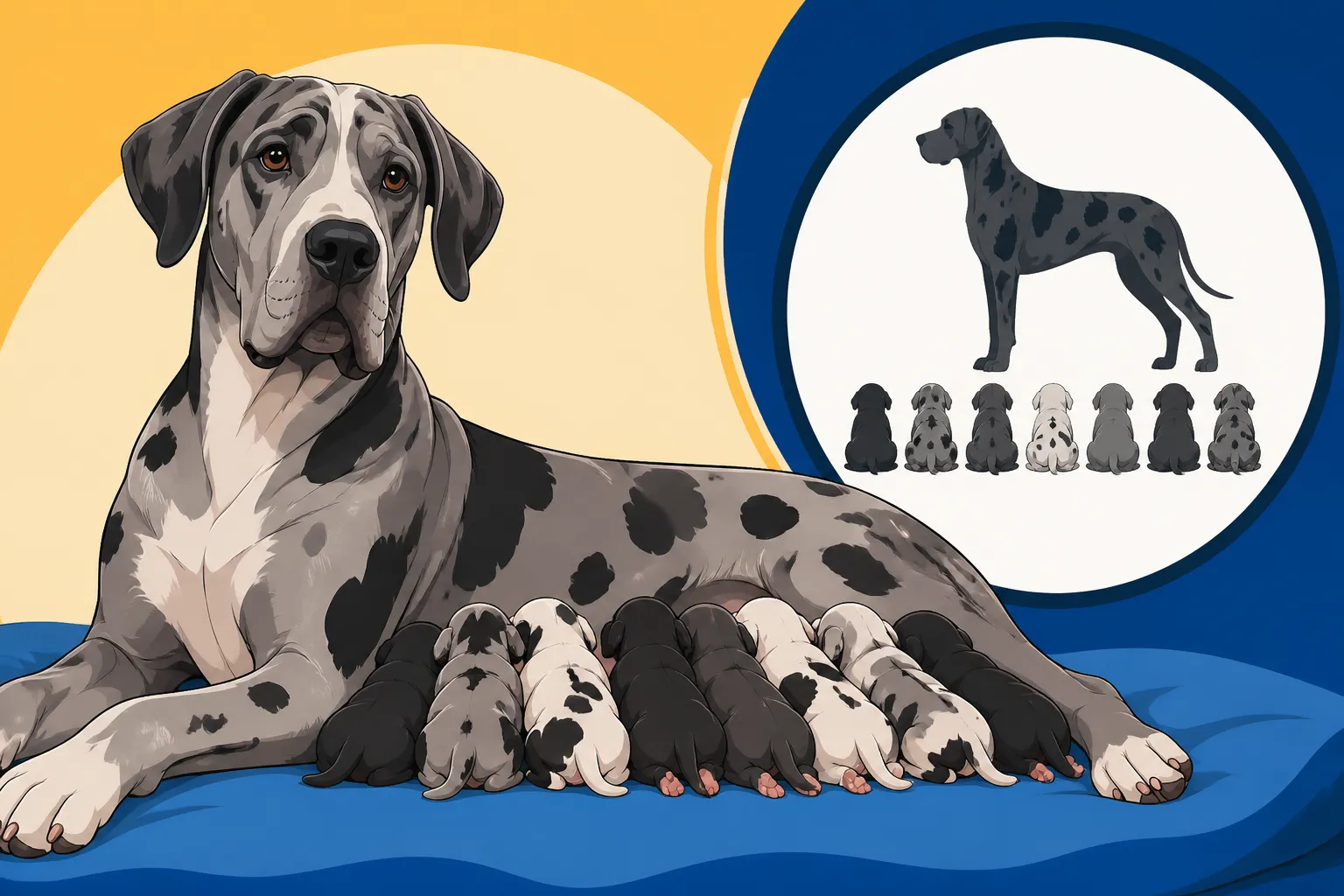
Great Danes are a giant breed, and their litters are often larger than those of smaller dogs. A litter of around eight puppies is a reasonable general expectation, but actual numbers vary considerably. A dam may have fewer puppies, or she may deliver a much larger litter. Neither outcome, by itself, tells you whether the pregnancy or birth will go smoothly.
It helps to think in ranges rather than a target. One Great Dane litter may have four puppies, while another may have twelve or more. Even two litters from the same dam can differ. Breed, individual health, reproductive history, and chance all play a part, so a breeder cannot promise an exact puppy count based on a mating date or a parent’s size.
There is also a difference between the number of puppies conceived, the number seen on an exam, and the number born alive. Very early pregnancy loss can occur, and puppies may be stillborn or die shortly after birth. When discussing litter size, ask what the number refers to rather than assuming every reported count means healthy puppies brought home.
Why a large litter is not automatically an easy litter
A larger litter can mean more puppies competing to nurse and more frequent checks for the breeder. A dam may need close supervision to make sure each puppy gets access to a teat and stays warm. If one puppy is consistently pushed aside, is weak, or fails to gain weight, it may need prompt veterinary attention and a carefully planned feeding approach.
A small litter can bring different concerns. With only one or two puppies, each may grow larger in the uterus because there are fewer puppies sharing space and resources. A large puppy can make delivery more difficult, although puppy size alone does not determine whether a dog will need veterinary assistance. A small litter should not be treated as proof that whelping will be simple.
For a fuller look at how litter size relates to breed characteristics, see Great Dane Litter Sizes. If you are choosing a puppy rather than planning a breeding, the breeder’s willingness to discuss pregnancy, delivery, and puppy outcomes matters more than a dramatic puppy-count claim. A responsible breeder should be candid about uncertainty and prepared to explain the care the litter received.
What affects a Great Dane litter size
The dam and her reproductive history
A dam’s age, health, reproductive history, and general condition can influence pregnancy and litter outcomes. That does not mean there is one ideal age or a simple formula for predicting how many puppies she will have. A veterinarian familiar with canine reproduction can assess whether an individual dog is an appropriate breeding candidate and discuss risks specific to her health.
A first litter is not reliably smaller or larger than later litters. Some breeders notice patterns in an individual dog, but previous litter size is not a guarantee for the next pregnancy. The sire, timing, fertility, and natural variation also matter. Guessing from the number of puppies in a dam’s family line is not a substitute for veterinary evaluation.
Health and welfare should come before trying to produce a particular number of puppies. Before breeding, discuss the dam’s physical condition, inherited health concerns, reproductive history, and the practical demands of pregnancy and raising a litter. The Health Testing a Great Dane Breeder Owes You is useful background on why responsible planning involves much more than choosing two attractive dogs.
Mating, fertility, and chance
Breeding timing can affect whether conception occurs, but even carefully planned mating does not guarantee pregnancy or a certain litter size. A mating may result in no puppies, a small litter, or a larger one. If a breeder is unsure whether a mating was successful, a veterinarian can advise on the right way to confirm pregnancy and monitor the dam.
Fertility issues can involve either dog, and they are not always obvious from appearance or behavior. A reproductive veterinarian may review health history, examine the dogs, and recommend appropriate testing. Repeatedly breeding without understanding why a dog is not conceiving can add stress and risk without solving the underlying problem.
It is also worth being wary of anyone who claims they can reliably produce a specific Great Dane litter size through a supplement, feeding trick, or home method. Nutrition supports the dam’s health, but it cannot guarantee a chosen number of puppies. For broader background on the breed and responsible sourcing, read Where People Actually Find a Great Dane and What a Great Dane Breeder Should Be Screening For.
How veterinarians estimate and confirm puppy numbers
What pregnancy tests can and cannot tell you
A veterinarian may use different exams at different points in pregnancy to confirm that a dog is pregnant and assess how things are progressing. Ultrasound can help identify pregnancy and evaluate fetal activity, but it is generally not the most reliable way to count every puppy in a large litter. Puppies may overlap on the screen, making an exact count difficult.
Later in pregnancy, radiographs may help a veterinarian estimate the number of puppies because their skeletons are visible. Even then, counting can be challenging if puppies overlap or are positioned awkwardly. A count is an estimate to support planning, not a promise that exactly that many puppies will be delivered alive.
Ask the veterinarian what the test can answer, what remains uncertain, and whether another exam is useful. That conversation can prevent a common misunderstanding: hearing “we can see puppies” and assuming the total is known. The vet’s estimate should help the breeder prepare, while the actual birth still needs to be monitored carefully.
Why a puppy count matters for delivery planning
Knowing the likely litter size can help a veterinarian and breeder discuss delivery plans and what to watch for during labor. A planned veterinary contact is especially important for a giant breed, where both a large litter and a very small litter can raise different concerns. The dam’s history, exam findings, and the position and size of puppies all contribute to the plan.
A count can also help the breeder recognize when delivery may be incomplete. If the dam has delivered several puppies but still appears to be in labor, or her behavior changes in a worrying way, contact a veterinarian rather than trying to decide at home whether more puppies remain. Do not rely on a rough estimate to rule out an emergency.
Keep the clinic’s contact information and transport plan ready before the due period. This is not the moment to search for an open clinic while a distressed dog is laboring. A discussion about The Great Dane Against the Mastiff can help explain how giant breeds differ in size and care needs, but delivery decisions should be based on the individual dog and veterinary advice.
| Question | What to keep in mind |
|---|---|
| How many puppies are typical? | Around eight is a useful general expectation, not a guarantee. |
| Can a breeder know the exact number in advance? | Veterinary imaging can estimate a count, but estimates may not be exact. |
| Is a small litter always safer? | No. A singleton or small litter can present its own delivery concerns. |
| Does a large litter always mean a difficult birth? | Not necessarily, but it may require more intensive monitoring and puppy care. |
| Can food or supplements set the litter size? | No feeding approach can guarantee a specific number of puppies. |
Preparing for the dam and her puppies
Plan for care, not just a number
Even when an exam suggests a modest litter, prepare for the possibility of more puppies than expected. Have a clean, quiet whelping area, a way to monitor the dam and newborns, and a clear plan for veterinary help. The setup should be practical for a very large dog: there should be room for her to lie down comfortably while allowing the breeder to check puppies without crowding or unsafe handling.
Newborn puppies need close observation, warmth, and access to nursing. A breeder should be able to notice if a puppy is cold, unusually quiet, unable to latch, or repeatedly separated from the dam. Keeping a written record of each puppy’s weight and condition helps reveal changes that might be hard to spot by eye, especially when puppies look very similar.
Supplies can make the work more manageable, but they do not replace experienced care. Some breeders use washable bedding, absorbent pads, a reliable scale, and cleaning supplies; options such as puppy pads and basic care items are available through retailers including Chewy. Choose supplies that suit the whelping setup and your veterinarian’s recommendations, rather than buying products that promise to prevent complications.
Recognize when professional help is needed
Before the pregnancy reaches its final stage, ask the veterinarian which signs mean you should call immediately. Those instructions should be specific to the dam, her exam findings, and the clinic’s advice. Do not wait for a particular number of puppies to be born before seeking help if the dam is distressed, extremely weak, or showing other alarming changes.
After delivery, veterinary guidance remains important. A puppy that is not nursing, is losing weight, or seems weak needs prompt attention. The dam also needs monitoring for signs of illness or difficulty recovering. Avoid trying to diagnose or treat a newborn puppy with household remedies; very young puppies can deteriorate quickly, and feeding or warming decisions may depend on the cause of the problem.
A careful breeder plans both for routine care and for the possibility that the birth does not go as expected. That means arranging veterinary support, knowing how puppies will be monitored, and being realistic about the time and resources a litter requires. For related preparation, see The Kit a Great Dane Puppy Needs First and Great Dane Litter Sizes. If you are considering bringing one puppy home, Questions to Ask Before Taking a Great Dane can help you assess the breeder’s approach and the puppy’s early care.
Disclaimer
This article is for general informational purposes only and does not constitute professional advice. Laws, prices and regulations vary by location and change over time. Consult a qualified professional for guidance on your specific situation.