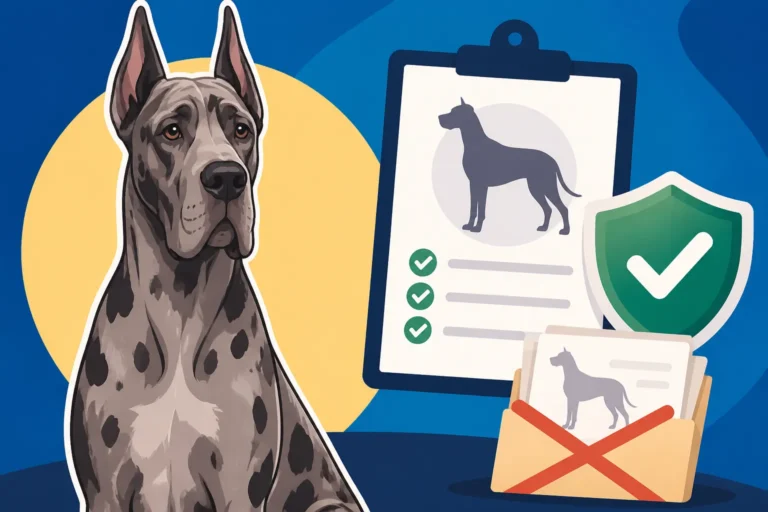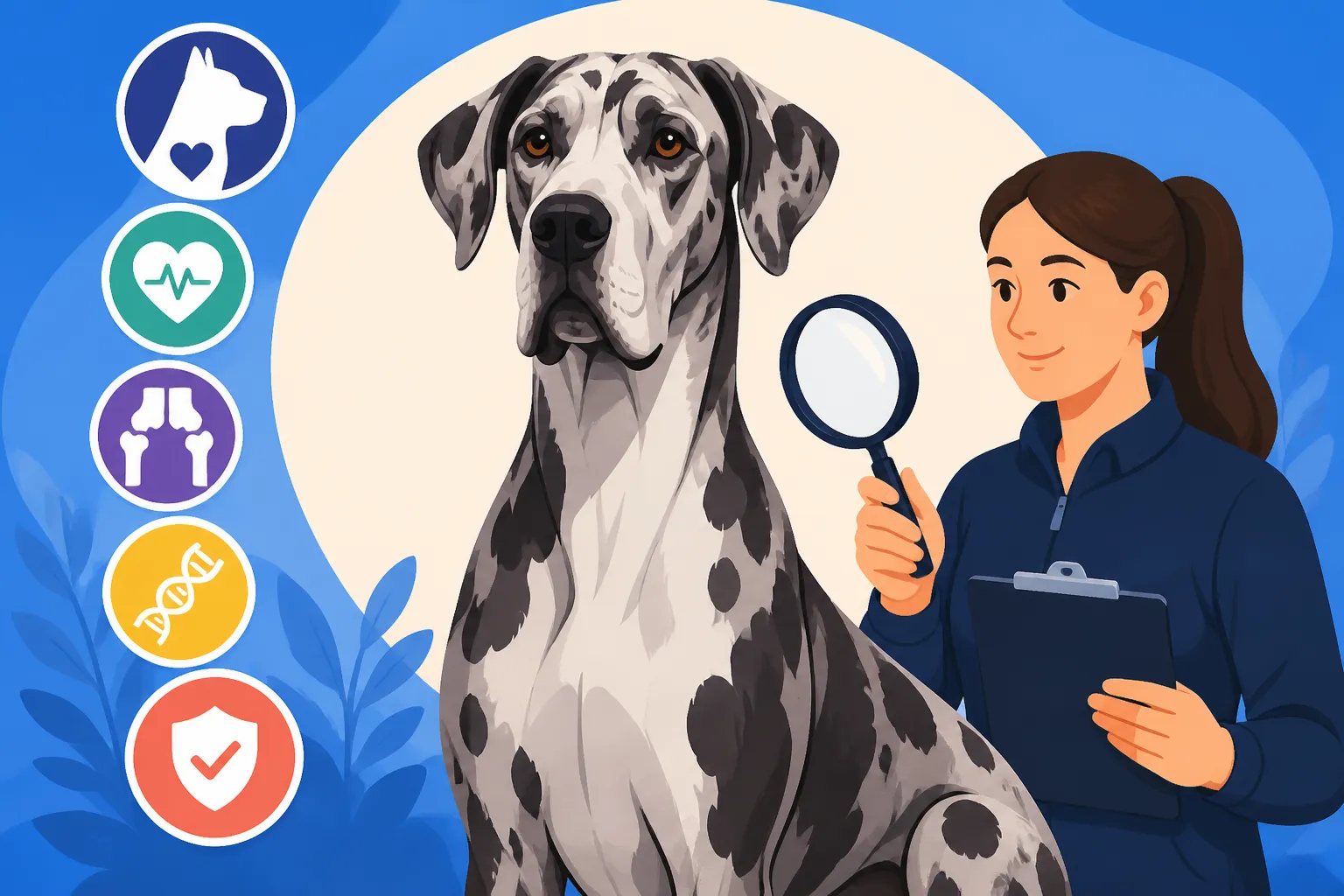
What a Great Dane Breeder Should Be Screening For
Choosing a Great Dane breeder can feel overwhelming when every puppy listing promises “healthy parents.” The useful question is what that promise is backed by: documented screening, results you can verify, and honest discussion of health in the family line. This guide explains which checks to ask about, how to read the paperwork, and what should make you pause before placing a deposit.
Health screening to ask a Great Dane breeder about
There is no single test that can guarantee a puppy will never become ill. Good screening instead helps identify risks, gives breeders better information for mating decisions, and helps buyers understand what is known about the puppy’s parents and relatives. Ask for actual reports, not just a verbal assurance that the dogs are “vet checked.”
Heart screening and family history
Heart health deserves particular attention in Great Danes because dilated cardiomyopathy, or DCM, is a serious concern in the breed. A routine physical exam can be useful, but it is not the same as a cardiac evaluation designed to look for changes in heart function or rhythm. Ask what testing the sire and dam have had, who performed it, when it was done, and whether the breeder can show you the results.
A breeder should be comfortable explaining that one normal check is not a permanent guarantee. Some heart conditions can develop later, so ask whether adult dogs are screened again over time and whether close relatives have had heart disease, fainting episodes, or unexplained early deaths. The details matter: “No one has mentioned a problem” is not as informative as a clear account of the family’s history and the screening completed.
If a breeder dismisses heart questions as unnecessary, or offers only a basic vaccination record as proof, slow down. For more detail on ongoing assessment, read Screening a Great Dane's Heart Each Year. You can also ask your veterinarian what records to bring to your puppy’s first visit so the conversation starts with the parents’ documented results rather than guesswork.
Hip and elbow evaluations
Great Danes grow quickly and carry substantial weight, so joint health is an important part of a responsible breeding plan. Ask whether the parents have had hip and elbow evaluations through a recognized screening program, and request the official reports. A breeder’s statement that the dogs “move beautifully” is not a substitute for imaging and a recorded evaluation.
Check that the paperwork belongs to the actual sire and dam, and that the dogs were old enough for the type of final assessment being presented. Preliminary evaluations can offer useful information, but they are not necessarily equivalent to a final result. A responsible breeder should explain what the report means, including any limitations, rather than simply showing a certificate without context.
Joint screening cannot predict every puppy’s outcome. Growth, body condition, activity, and other factors also play a role. Still, verified results offer a much stronger starting point than appearance alone. For a deeper explanation of what to ask for, see Great Dane Hip and Elbow Screening and Great Dane Hips, Elbows and Growing Joints.
Thyroid, eye, and other relevant checks
Ask whether the breeder follows appropriate thyroid and eye screening for the parents and whether any findings have affected breeding decisions. The exact testing approach can depend on the dog, its history, and the recommendations used by the breeder’s veterinary team. A good breeder should be able to tell you what was tested, when, and what the result showed.
Be wary of a blanket claim that “all genetic tests were done” without a list of tests and reports. A commercial DNA panel may provide useful information about particular inherited conditions, but it does not replace heart, joint, eye, or thyroid evaluations. Nor does a clear result for a limited set of variants mean a dog is free of every inherited health risk.
Ask the breeder to explain which tests they consider relevant to the dogs in front of you and why. You can learn more about one thyroid-related question in The Thyroid Test a Slow Great Dane Needs. The broader checklist in The Health Testing a Great Dane Breeder Owes You is also useful when you want to compare a breeder’s testing claims with a more complete health-screening conversation.
How to verify the breeder’s claims
Good breeders usually expect thoughtful questions. They may not have an instant answer to every detail, but they should be willing to find the record, explain the result, and tell you what they know about health concerns in the family. Verification is not an accusation; it is part of making an informed decision about a giant-breed dog.
Ask for reports, not reassuring phrases
Request copies of the parents’ relevant screening reports and confirm that the names or identifying information match the dogs in the litter’s pedigree. If results are available through a public health registry, ask how to locate the entries. A screenshot or certificate can be a starting point, but it should be clear enough to identify the dog, test, result, and date.
Pay attention to how the breeder handles a result that is not perfect. Responsible breeding is not always a story of flawless reports. What matters is whether the breeder understands the finding, has discussed it with appropriate professionals, and can explain how it influenced the decision to breed that dog. A breeder who is candid about limitations may be more trustworthy than one who insists there is no risk at all.
Keep a copy of the documents you receive. When your puppy has its first veterinary examination, bring the records along with vaccination and deworming information. Knowing what was screened in the parents helps your veterinarian understand the background, but it does not replace routine examinations or monitoring as the puppy grows.
Look beyond the sire and dam
A puppy inherits more than a pair of test reports. Ask about the health and longevity of grandparents, siblings, half-siblings, and previous puppies from the same parents. Useful questions include whether relatives developed heart disease, significant joint problems, cancer, thyroid disease, or other conditions, and at what ages those issues appeared.
Listen for answers that include both reassuring and difficult information. A breeder may not know every detail about every distant relative, particularly if a dog lives with another family. Still, they should make a reasonable effort to collect feedback from puppy buyers and should not conceal a pattern they know about. Ask how they stay in touch with previous owners and whether they encourage updates over the dog’s life.
Family history is not a crystal ball, but it can reveal patterns that a single screening result misses. Great Danes have a relatively short average lifespan compared with many smaller dogs, which makes honest discussion about longevity especially important. Why a Great Dane Only Lives Seven to Ten Years provides context for why the family’s health history matters when choosing a puppy.
Use a practical breeder-question checklist
It helps to write questions down before a call or visit. In the excitement of meeting puppies, it is easy to forget details or accept a vague answer because the puppy is charming. Ask one question at a time and give the breeder room to explain.
| What to ask | What a helpful answer includes | A reason to pause |
|---|---|---|
| What heart screening have the parents had? | Test type, date, professional or registry, and results | “They’re healthy” with no records |
| Were hips and elbows evaluated? | Identifiable reports and an explanation of the findings | “They don’t limp, so they’re fine” |
| What do you know about health in the family line? | Specific known issues, ages, and limits in what is known | Refusal to discuss relatives or prior litters |
| What other screening is relevant for these parents? | Tests named and explained in context | A vague claim that every possible test was done |
| Can I review the puppy’s records and contract? | Time to read the documents before committing | Pressure to pay before sharing basic information |
Use the same approach when reading the puppy’s paperwork. Reading a Great Dane Puppy's Health Papers can help you separate a veterinary record from parental screening evidence. A vaccination record shows care the puppy has received; it does not prove that the parents underwent the health evaluations needed for responsible breeding.
What screening can and cannot tell you
Health tests are valuable, but they are only one part of choosing a breeder. A careful program combines documented results with sound judgment, good care, and an ongoing willingness to learn from dogs after they leave the litter. No certificate should be presented as a promise that a puppy will be free from disease throughout life.
A clear result is not a lifetime guarantee
A normal result describes what was found by a particular test at a particular time. It cannot rule out every disease, predict every later change, or account for all environmental and developmental influences. This is especially important for conditions that may become apparent as a dog ages.
Ask how old the parents were when tested and whether the screening is one-time or repeated. When a condition can emerge later, a dated report from years ago may not answer whether the dog has been monitored since. A conscientious breeder can explain what the available evidence says without overselling it.
This is also why a veterinarian’s puppy examination is important even when the breeder provides extensive paperwork. The exam gives your own veterinary team a baseline for the individual puppy. It is a separate safeguard, not an accusation that the breeder has failed.
DNA panels have a specific role
DNA testing can be useful when it addresses a known, relevant inherited variant. Ask which condition each test covers and how the result affects a breeding decision. For some inherited conditions, a carrier result does not automatically mean a dog must never be bred; the appropriate decision depends on the condition, inheritance pattern, and planned mate. The breeder should be able to explain that reasoning clearly.
Do not treat a large number of DNA results as a universal health certificate. A panel cannot stand in for physical examination, cardiac assessment, joint imaging, or a careful family history. If the breeder says a panel proves the puppy is “genetically perfect,” ask what that phrase specifically means and what the panel did not test.
A thoughtful breeder is interested in the limits as well as the benefits of testing. They should not imply that a buyer can skip routine veterinary care because the parents passed screening or because a puppy has a DNA report.
Red flags and the decision to walk away
A puppy can be irresistible, and it is uncomfortable to step back when a breeder has already made you feel chosen. But pressure, missing documents, and evasive answers are reasons to pause—not reasons to rush. The goal is to find a breeder whose practices and communication give you confidence before you bring home a very large dog with a long-term commitment.
Warning signs in screening and communication
Be cautious if a breeder refuses to show results, says testing is unnecessary because the dogs look healthy, or cannot explain which tests were performed. Other warning signs include presenting a basic vet check as equivalent to specialist screening, claiming that a single test eliminates all risk, or discouraging you from speaking with your own veterinarian.
Also notice whether the breeder talks about the dogs as individuals. A responsible breeder should be able to describe strengths and concerns, and to explain why a particular pairing was chosen. If the conversation is focused only on color, size, or how quickly you can pay, it may not give enough attention to health and temperament.
Take time to read the contract and ask what happens if a serious health issue appears. A contract is not a substitute for screening, but it can show whether the breeder has thought through their responsibilities after a puppy goes home. For a related overview, see What a Great Dane Contract Usually Says.
Make the decision without rushing
Ask to review the records before sending a deposit, and do not let a short deadline replace due diligence. If something is unclear, request the report or ask for time to discuss it with your veterinarian. A breeder who is acting responsibly should understand why a buyer wants to verify health claims.
Meeting the dam can give you useful context about her behavior, condition, and the environment in which the litter is being raised. It does not establish that she has passed health screening, so treat the visit and the paperwork as separate pieces of evidence. Seeing the Dam Before Buying a Great Dane offers more guidance on what a meeting can—and cannot—tell you.
Finally, remember that screening is part of a broader picture. Ask about early handling, socialization, veterinary care, and how the breeder chooses homes for puppies. If you want a wider set of questions to take into a conversation, use Questions to Ask Before Taking a Great Dane. You should leave the discussion with a clearer understanding of the risks, the records, and the breeder’s approach—not simply a promise that everything will be fine.
Keep health evidence separate from shopping decisions
A breeder may recommend a particular food or send a small amount home with the puppy. That can help you avoid an abrupt diet change, but a food recommendation is not evidence that the parents were screened. If you later compare food options through Chewy or another retailer, use the label and your veterinarian’s advice to guide that separate decision.
Likewise, a product listing on Chewy cannot verify a breeder’s health claims. Keep screening reports, veterinary records, and purchase receipts in distinct folders so you can find the important medical documents quickly. If you order supplies through Chewy, save those receipts separately from the puppy’s health paperwork; the records answer different questions.
Disclaimer
This article is for general informational purposes only and does not constitute professional advice. Laws, prices and regulations vary by location and change over time. Consult a qualified professional for guidance on your specific situation.