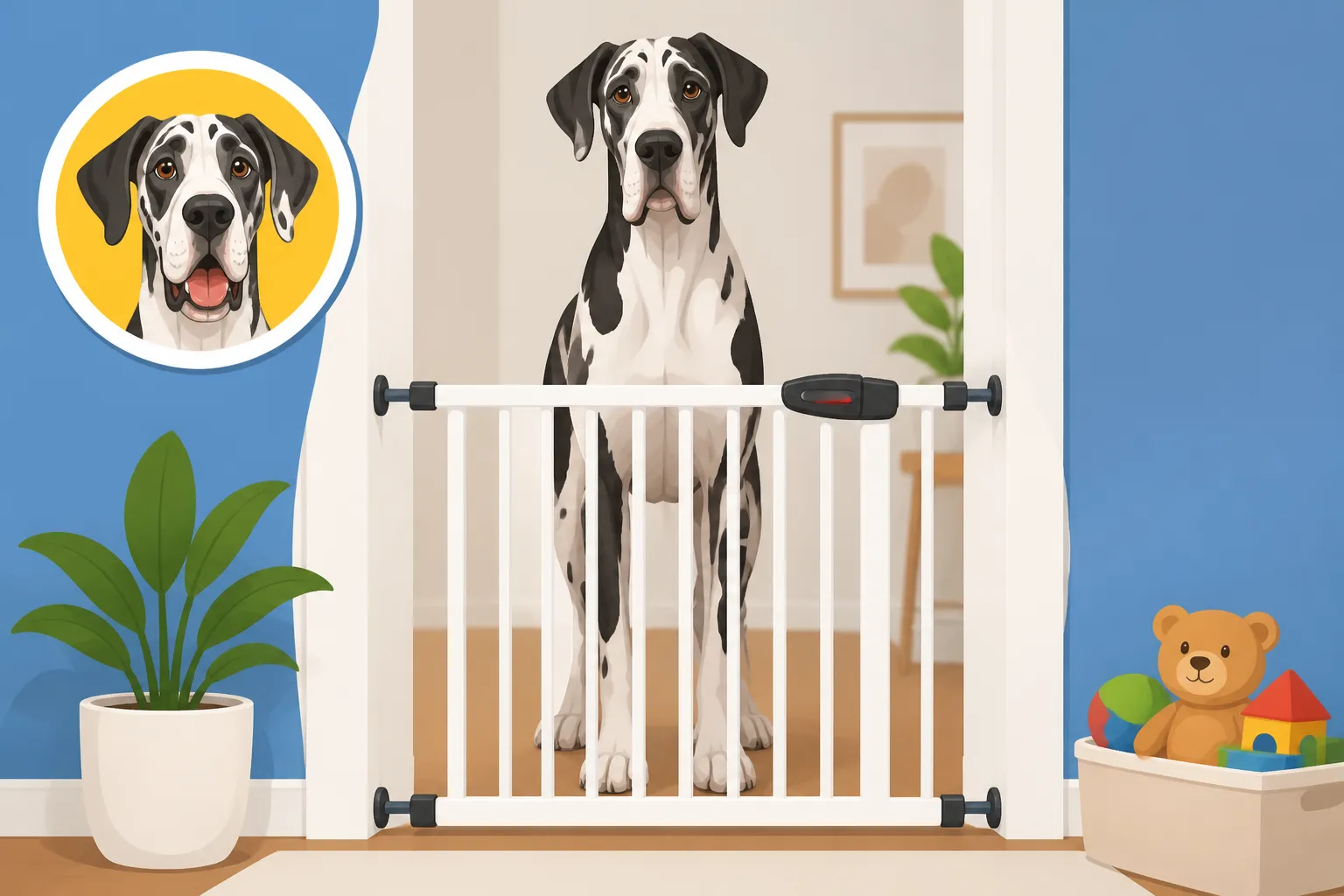
Baby Gates a Great Dane Cannot Step Over
One of the trickiest parts of living with a magnificent Great Dane is realizing that your average household barriers just don't cut it. You might have tried standard baby gates only to find your gentle giant simply steps over them, or worse, leans against them with enough force to send them flying. This guide is here to help you navigate the world of gate solutions, ensuring your Great Dane stays safely contained where you need them to be, without constantly finding new ways to outsmart your efforts.
The Unique Challenges of Containing a Great Dane
Bringing a Great Dane into your home is an incredible joy, but it also means a serious re-evaluation of your home's infrastructure. These aren't just big dogs; they're huge dogs, with a combination of height, strength, and surprising agility that makes conventional containment strategies utterly useless. What works for a Labrador or even a German Shepherd often won't hold a determined Dane.
Why Standard Baby Gates Just Don't Cut It
Most baby gates are designed to contain human toddlers, who are significantly shorter and less powerful than even a Great Dane puppy. Your average gate stands about 28 to 32 inches tall. For a Great Dane, that's barely a hurdle. They can easily clear such a height with a casual step, or a simple hop if they're feeling particularly spry. It’s a frustrating moment when you install a brand-new gate, feeling secure, only to watch your Dane calmly lift a leg and step over it as if it were a fallen twig. This isn't usually an act of defiance; it's simply a matter of scale. They genuinely don't perceive it as a barrier.
Beyond height, there's the sheer mass and strength of a Great Dane to consider. An adult male Great Dane can easily weigh upwards of 140-150 pounds, and a large female isn't far behind. Pressure-mounted gates, which rely on tension to stay in place, are no match for this kind of weight. A Great Dane leaning against one, or even bumping it playfully, can dislodge it in an instant. We’ve all heard stories of gates clattering to the floor, leaving the Dane looking bewildered but free to roam. These gates can also be a safety hazard, as a collapsed gate can startle a dog or even trip a person.
Assessing Your Dane's Jumping and Leaning Habits
While Great Danes are often called "gentle giants," this doesn't mean they're incapable of exerting considerable physical power when they want to. Some Danes are quite athletic and can clear impressive heights, while others are more prone to using their bulk to push or lean. It's crucial to honestly assess your individual dog's tendencies. If your Great Dane is a jumper, you'll need maximum height. If they're a "leaner" or "pusher," you'll need extreme stability and robust construction.
Even if your Dane isn't typically a jumper, remember that an enticing smell from the kitchen, a visitor at the door, or simply a burst of playful energy can prompt them to attempt to clear a barrier they normally wouldn't. Don't underestimate their curiosity or their ability to test boundaries. They are intelligent dogs, and they learn quickly what works and what doesn't. A gate that wobbles even a little under a test nudge will soon be identified as a weak point. This is why consistent training from a young age is so important, reinforcing good behavior around barriers. Think about whether you’ve put in the time Paying to Train a Great Dane Early to establish these rules.
Essential Features of a Great Dane-Proof Gate
When you're shopping for a gate to contain a Great Dane, you need to abandon the mindset of buying a typical baby gate. You're essentially looking for a piece of heavy-duty equipment designed for a large, powerful animal. Every feature needs to be considered through the lens of a dog that could weigh more than a grown human.
Height is King: How Tall Does it Need to Be?
This is arguably the most critical factor. For a Great Dane, a gate needs to be significantly taller than you might initially imagine. While a general rule for dogs is that a gate should be at least one-and-a-half times their standing height at the shoulder, with Great Danes, you often need to go even further. Look for gates that are a minimum of 40-42 inches tall. Many Great Dane owners find success with gates in the 48-inch range, and some even opt for 50-inch or taller gates, especially if their Dane is particularly tall or a known jumper.
It's not just about the gate itself; consider your door frames and the surrounding wall. A gate that's very tall might necessitate careful installation, ensuring it doesn't interfere with existing architectural features. Remember that even if the gate is tall enough to prevent jumping, a Great Dane might still try to lean over the top, so ensure the material is sturdy and doesn't bend or flex easily at that height.
Durability and Mounting: Withstanding the Force of a Dane
Given their size and strength, the construction and mounting method of your Great Dane gate are paramount. Flimsy plastic or thin wooden gates are absolutely out of the question. You need materials that can withstand significant impact and sustained pressure.
- Material: Heavy-gauge steel is the gold standard for Great Dane gates. It's strong, durable, and less likely to break or bend under pressure. Some heavy-duty wooden gates can work, but they must be exceptionally well-built with thick, reinforced frames. Always check the gauge of the steel or the thickness of the wood.
- Mounting: This is where many standard gates fail. Hardware-mounted gates are almost always superior and safer for Great Danes than pressure-mounted ones. Pressure-mounted gates rely on tension to hold them in place, and a Great Dane can easily dislodge them, leading to escapes and potential injuries. Hardware-mounted gates, on the other hand, screw directly into your doorframe or wall studs, creating a much more secure and permanent barrier. While installation involves drilling, the peace of mind and safety it provides is invaluable. If you must use a pressure-mounted gate for a very temporary, low-stakes situation (like keeping a calm, older Dane out of a room for a few minutes), ensure it's specifically rated for large breeds and continuously monitor its stability. For permanent solutions, always opt for hardware mounting.
- Reinforcement: Even with hardware mounting, consider adding wall protectors or reinforcing plates, especially on drywall, to distribute the pressure and prevent damage to your walls over time. Look for gates that have multiple mounting points for extra security.
Gate Width and Installation Considerations
Great Danes often live in homes with wider doorways or open-plan areas. Standard gates might not span these openings, so you'll need gates that accommodate extra-wide spaces, often with extension kits. Carefully measure the width of the opening where the gate will be installed. Don't just eyeball it; grab a tape measure and get precise dimensions. Many large dog gates come with various extension panels that allow them to fit openings from 28 inches up to 60 inches or more.
When choosing a gate, also think about how you will use it. You'll be opening and closing this gate many times a day, often with groceries, laundry, or other items in your hands. Look for features like one-handed operation, an auto-close mechanism, and a "hold-open" feature for when you need to pass through multiple times. A gate that's difficult for you to operate quickly becomes a nuisance, and you might be tempted to leave it open, defeating its purpose. Remember to check out general resources like What to Buy Before a Great Dane Arrives to ensure you're ready for all the necessary equipment.
Types of Gates That Work for Great Danes
Finding the right gate for your Great Dane isn't just about height; it's also about understanding the different construction types and how they stand up to a large, active dog. You have options, but some are definitely better suited for the task than others.
Extra-Tall Pressure-Mounted Gates: For Lower-Impact Areas
While generally not recommended for Great Danes, there are some extra-tall pressure-mounted gates available that might be suitable for very specific, low-impact scenarios. These gates stand taller than typical baby gates, often reaching 36 to 41 inches, which is an improvement over the standard. However, they still rely on friction and tension to stay in place, making them vulnerable to a determined Great Dane.
When they might work:
- For an older, very calm Great Dane who has absolutely no inclination to push, jump, or lean.
- As a temporary visual barrier, rather than a truly secure physical one, in areas where escape isn't catastrophic.
- In situations where hardware mounting is absolutely not an option (e.g., in a rental property with strict rules against drilling).
Limitations and Risks:
- Stability is still an issue. Even a gentle nudge can sometimes dislodge these gates, especially if they are not perfectly installed or if the tension slackens over time.
- Safety hazard. If a large dog leans on it and it gives way, the gate can fall on the dog or a person.
- Great Danes are smart. If they learn a gate can be pushed, they will exploit it.
If you consider this type of gate, look for brands that specifically market their pressure-mounted gates as "extra-strong" or "pet gates" for large breeds, rather than "baby gates." They might feature wider pressure points or reinforced frames. However, always exercise extreme caution and never rely on them for critical containment.
Heavy-Duty Hardware-Mounted Gates: The Gold Standard
For the vast majority of Great Dane owners, a heavy-duty, hardware-mounted gate is the most reliable and safest choice. These gates are designed to be permanently affixed to a wall or door frame, providing a much more robust and secure barrier that can withstand the weight and force of a Great Dane.
Why they are preferred:
- Superior Stability: Screwed directly into studs or with appropriate anchors, these gates don't budge. This prevents accidental escapes and eliminates the risk of the gate falling over.
- Durability: Typically constructed from thick steel or very strong, solid wood, they are built to last and endure years of a Great Dane's daily interactions. Look for gates with strong latching mechanisms that require a definite action to open, preventing accidental releases.
- Peace of Mind: Knowing your Great Dane is safely contained means you don't have to constantly worry about them getting into mischief, like A Great Dane That Takes Dinner Off the Table, or escaping into an unsafe area.
When selecting a hardware-mounted gate, prioritize models that are explicitly designed for large breeds. Some gates even feature vertical bars that are closer together to prevent smaller heads from getting stuck, though this is less of a concern with Danes. Brands like Carlson Pet Products or Regalo often have lines of extra-tall, extra-wide, and all-steel gates that fit the bill. You might find these specific types of gates, as well as other giant dog supplies, readily available through online retailers like Chewy, which specializes in pet products. For everyday necessities like proper food, even services like Ollie, which deliver fresh pet food, cater to the significant dietary needs of a Great Dane, ensuring they have the energy to respect those boundaries, not break them. Don't forget to consider Crates and Gates Sized for a Great Dane as part of your overall home setup.
Custom and DIY Solutions for Challenging Spaces
Sometimes, even the most robust commercial gates don't quite fit your needs or the unique layout of your home. This is where custom or DIY solutions come into play, offering tailored containment for those especially challenging areas.
When off-the-shelf gates aren't enough:
- Extra-wide or irregularly shaped openings: Some archways or very wide room transitions simply exceed the capabilities of even extended commercial gates.
- Unusual mounting surfaces: Stone walls, half-walls, or areas with no convenient studs for mounting.
- Aesthetic preferences: You might want a gate that blends seamlessly with your home's decor, perhaps matching existing woodwork or finishes.
Hiring a carpenter or building your own:
If you're handy with tools, building your own gate can be a rewarding project. You have full control over the dimensions, materials, and aesthetics. Using sturdy wood like oak or pine, reinforced with metal brackets, can create a beautiful and bomb-proof barrier. Ensure all hardware—hinges, latches, and mounting screws—are heavy-duty and rated for significant weight. A cross-brace design can add extra rigidity to a tall wooden gate.
Alternatively, consider hiring a local carpenter or handyman who specializes in custom home solutions. They can design and build a gate that perfectly fits your space and integrates with your home's style. This option might be more expensive upfront, but it guarantees a perfect fit and robust construction. Remember to specify that the gate must be able to withstand a large, strong dog like a Great Dane, and discuss the necessary mounting techniques. This investment, much like having pet insurance from a provider like Healthy Paws for unforeseen vet bills, can save you stress and expense in the long run. Thinking about Pens and Gates Instead of a Great Dane Crate might also lead you to these custom solutions.
Strategies for Effective Gate Usage and Training
Having the right physical gate is only half the battle. To truly succeed in managing your Great Dane's access within your home, you need to combine that sturdy barrier with consistent training and smart placement. A gate is a tool, and like any tool, it works best when used correctly.
Training Your Great Dane to Respect Boundaries
A physical barrier is important, but a well-trained Great Dane who understands and respects boundaries is even better. Start training early, ideally when your Dane is a puppy and still manageable in size. Use positive reinforcement techniques to teach commands like "wait," "stay," and "off-limits."
- Consistency is key: Every time you use the gate, reinforce the rules. Don't let your Dane push past it, jump on it, or paw at it. If they try, calmly redirect them and ask for a "sit" or "stay" before you open the gate or pass through.
- Practice with rewards: Practice having your Dane wait patiently while you open and close the gate. Reward them generously with treats and praise when they comply. This teaches them that good behavior around the gate leads to positive outcomes.
- Leash work: Even with a gate, continue working on training a Great Dane to leave food alone and other impulse control commands. A gate is an extension of these lessons.
Remember, a Great Dane is a large, powerful dog. You want them to choose to respect the gate, rather than just being physically stopped by it. This foundational training builds a more harmonious relationship and makes the gates truly effective.
Placement and Purpose: Where to Use Your Great Dane Gate
Strategic placement of your Great Dane gates is crucial. Think about the specific areas you need to control and why.
- Kitchen: Often a high-traffic, high-value area for dogs, especially those prone to counter-surfing. A sturdy gate can prevent your Dane from accessing tempting treats on counters or raiding the trash. This protects your food and prevents your Dane from ingesting something harmful.
- Off-limit rooms: Perhaps a guest room, a home office, or a nursery needs to be dog-free. Gates provide a clear boundary.
- Creating "safe zones": Gates can be used to create a quiet, secure space for your Great Dane when you have visitors, or when you need them to settle down away from the main activity. This can be particularly useful for puppies who are still learning house manners or for older Danes who need their rest.
- Stairwells: Gates at the top and bottom of stairs are essential for preventing falls, especially in Great Dane puppies who are still developing coordination, or older Danes with Arthritis in a Six-Year-Old Great Dane.
Before installing, walk through your home and identify all the critical points where you need containment. Consider not only where your Dane can go, but where they shouldn't go for their own safety and your sanity.
Safety First: Avoiding Gate-Related Hazards
While gates are meant to enhance safety, improper selection or installation can introduce new risks. It’s important to be mindful of potential hazards.
- Gaps: Ensure there are no gaps between the gate and the wall that are large enough for your Great Dane's head or limbs to get stuck. While Danes are large, a determined puppy or a curious adult might try to squeeze through a seemingly small opening.
- Stability: Regularly check hardware-mounted gates to ensure all screws are tight and the gate remains securely affixed to the wall. For pressure-mounted gates (if you absolutely must use one for a temporary purpose), check the tension daily. A wobbly gate is an invitation for trouble.
- Stairs: If a gate is at the top of a staircase, it must be hardware-mounted and extremely secure. A pressure-mounted gate at the top of stairs is a serious fall hazard for both dogs and humans if it gives way.
- Pinch points: Examine the gate's hinges and latching mechanisms for any areas where paws or tails could be pinched.
By choosing the right gates, installing them correctly, and reinforcing their purpose with consistent training, you can create a safe, harmonious environment for your Great Dane and your family. Planning for expenses like this, as well as considering How Much Cash a Great Dane Owner Should Keep Ready for other emergencies, is a crucial part of responsible Great Dane ownership.
| Gate Type | Pros for Great Danes | Cons for Great Danes | Ideal Use Case |
|---|---|---|---|
| Pressure-Mounted | No drilling required, relatively easy to install. | Easily dislodged by leaning/jumping; less stable. | Temporary containment for very calm, non-pushing Great Danes, or visual barriers. |
| Hardware-Mounted | Extremely secure, withstands significant force, very stable. | Requires drilling for installation, more permanent. | Permanent containment for high-traffic areas, top of stairs, or active Great Danes. |
| Custom/DIY | Perfect fit for irregular openings, aesthetic matching. | Higher cost, requires skilled labor or DIY expertise. | Unique architectural spaces, specific aesthetic requirements, maximum security. |
Disclaimer
This article is for general informational purposes only and does not constitute professional advice. Laws, prices and regulations vary by location and change over time. Consult a qualified professional for guidance on your specific situation.