Crates That Hold a Full-Grown Great Dane
If you're a Great Dane owner, or dreaming of becoming one, you know the struggle is real when it comes to finding anything that truly fits their majestic size. One of the biggest head-scratchers for us is figuring out how to choose a crate that genuinely holds a full-grown Great Dane, offering them comfort and safety without feeling like a sardine can. This guide is here to walk you through exactly what you need to look for, dispelling common myths and helping you create a safe haven for your gentle giant.
The Unique Challenges of Crating a Full-Grown Great Dane
Let's be honest, living with a Great Dane means constantly recalibrating your idea of "large." What might be considered a spacious crate for a Labrador is nothing more than a glorified shoebox for a Dane. This isn't just about inconvenience; it's about their physical and mental well-being. Trying to squeeze a Great Dane into a crate that’s too small can lead to serious problems, and frankly, it's just not fair to them.
Why Standard Crates Just Don't Cut It
Most crates you see in standard pet stores are designed for average-sized dogs. When you bring home a Great Dane puppy, even a "large" puppy crate can quickly become inadequate. Great Danes grow at an astonishing rate, often reaching half their adult weight by six months old. This means that a crate that fit them comfortably a few weeks ago might suddenly be too cramped, preventing them from standing up straight, turning around without difficulty, or stretching out fully. Imagine being stuck in a tiny room where you can't even stand up properly – it's stressful and uncomfortable, and it can deter them from wanting to use their crate at all.
Furthermore, a crate that’s too small can lead to physical discomfort and even injury. If your Great Dane is constantly bumping against the sides or can't change positions freely, they might develop sores, muscle stiffness, or even orthopedic issues over time. These dogs are prone to Great Dane Hips, Elbows and Growing Joints as it is, so we really need to prioritize their physical comfort. A giant breed needs ample space to move, stretch, and relax, especially if they are going to spend any significant amount of time in their crate, whether for overnight sleep or supervised downtime.
Understanding Great Dane Growth and Crate Needs
The journey of choosing a crate often starts with a tiny, adorable Great Dane puppy. It's easy to get caught up in their cuteness and underestimate just how quickly they will transform into a towering adult. A puppy crate is a temporary measure, a stepping stone to their ultimate adult setup. You might find yourself needing a series of crates as your Great Dane puppy grows from a small bundle of fluff to a substantial adolescent, and then finally to a full-grown, magnificent adult. It's important to remember that these giants continue to fill out and mature even after their initial rapid growth spurts.
When your Great Dane is a puppy, a slightly smaller crate can be beneficial for house training, as dogs are naturally reluctant to soil their sleeping area. However, this strategy quickly becomes counterproductive once they start putting on significant size. You need to anticipate their adult size well in advance. Don't wait until they can barely squeeze through the door before upgrading. A good rule of thumb is to look for a crate that can comfortably accommodate them when they are fully mature, even if it means getting an oversized one for a short period while they are still growing. Many owners find themselves asking Whether a Great Dane Puppy Should Be Kept Lean to support their growth, and selecting the right crate is part of this holistic approach to health. It's about thinking ahead and investing in the long-term comfort of your big dog.
Essential Features to Look For in a Great Dane Crate
When you're shopping for a crate for a full-grown Great Dane, you're not just looking for "big." You're looking for specific dimensions, unyielding strength, and practicality that accounts for their sheer presence. This is where many well-meaning owners run into trouble, buying what they think will work only to find it quickly becomes inadequate or even unsafe.
Size: The Absolute Non-Negotiable
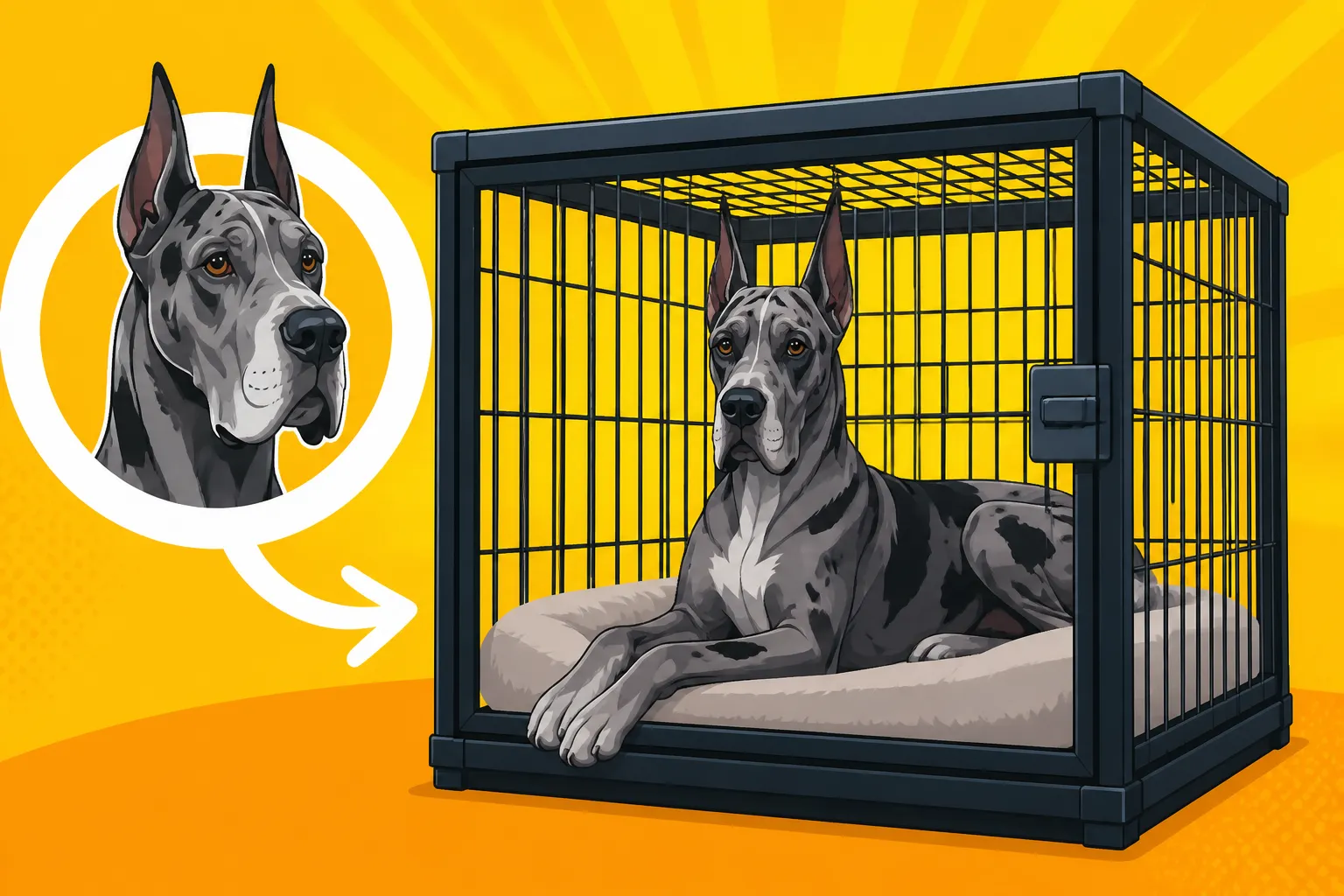
This is the single most critical factor. A full-grown Great Dane needs a crate that allows them to stand up, turn around, and lie down comfortably in any natural position, including stretching out. For most adult Great Danes, this means a crate that is at least 54 inches long. However, length isn't the only dimension to consider. Height is equally important. Many standard "extra-large" crates might be long enough for other large breeds, but they often lack the vertical space an adult Great Dane needs to stand without ducking their head. We’re talking about dogs that can easily stand over 30 inches tall at the shoulder.
Here's a quick guide to what you should be looking for in terms of dimensions:
| Dimension | Minimum for Adult Great Dane | Why It Matters |
|---|---|---|
| Length | 54 inches (approx. 137 cm) | Allows full stretch when lying down and comfortable turning. |
| Width | 36 inches (approx. 91 cm) | Enables comfortable turning and lying on their side. |
| Height | 45 inches (approx. 114 cm) | Crucial for standing fully upright without stooping. |
Always measure your dog from the tip of their nose to the base of their tail, and add about 4-6 inches for length. For height, measure from the floor to the top of their head when standing, and add 2-4 inches. When you’re looking at options on sites like Chewy, make sure to filter specifically for these extreme sizes. Remember, a crate should never be so large that it encourages your dog to eliminate in one corner and sleep in another, but for a Great Dane, "too large" is rarely the issue when it comes to length, width, and height. It's truly about finding Choosing a Crate a Great Dane Can Stand In.
Construction and Durability: Built to Last (and Resist Escape)
Let's face it, a Great Dane isn't just big; they're strong. A flimsy wire crate that might contain a smaller, calmer dog could be destroyed or even escaped from by a determined or anxious Great Dane. You need a crate that can withstand their power, especially if they are prone to anxiety or have "escape artist" tendencies. Look for crates made from heavy-gauge steel wire or even industrial-grade aluminum. The thicker the wire or metal, the better.
Pay close attention to the latches and welding. Standard flimsy latches are no match for a motivated Great Dane. Seek out crates with multiple, heavy-duty sliding bolt latches. The welds should be robust and even, showing no signs of weakness. Some Great Danes, particularly adolescents, can be quite destructive, chewing at bars or trying to bend them. An investment in a truly durable crate can save you from having to replace multiple cheaper options, not to mention the potential vet bills from injuries sustained during an escape attempt. If you have a particularly strong or anxious Dane, a more secure, impact-resistant crate might be worth the higher price tag. This can also save you the trouble of dealing with unexpected incidents that might lead to conversations with your pet insurance provider, like Healthy Paws.
Portability and Setup Considerations
While a Great Dane's crate is likely to be a permanent fixture in your home, you still need to consider how it arrives, how it's assembled, and if you ever need to move it. These massive crates are heavy, often weighing 50 pounds or more. Can you manage to set it up by yourself, or will you need a second set of hands? Many of the larger wire crates for Great Danes are designed to fold down for easier transport, which can be a huge benefit if you ever need to move house or rearrange your space.
Look for features like a removable tray for easy cleaning, which is essential for managing dirt and occasional accidents. Wheels with locks can be a game-changer for moving such a bulky item around without scratching your floors. Some crates also come with dividers, which can be useful if you're using a full-sized crate for a growing puppy to gradually expand their space, helping with Crate Training a Great Dane That Fills the Room. However, for an adult Dane, the primary concern is usually static placement and stability. Ensure it has rubber feet or pads to protect your flooring and keep the crate from sliding around when your dog moves inside it.
Types of Crates and Their Suitability for Great Danes
Just as not all crates are created equal in size, they also differ significantly in design and material, each offering pros and cons. Understanding these differences is key to choosing the best "home within a home" for your big dog.
Wire Crates: Pros, Cons, and Considerations
Wire crates are the most common type you'll encounter, and for good reason. They offer excellent ventilation, allowing for plenty of airflow, which is especially important for a large dog that can easily overheat. The open design also allows your Great Dane to see what's going on around them, which can be comforting for some dogs who don't like to feel isolated. They are generally more affordable than heavy-duty options and often fold flat for storage or transport. For dogs that are already accustomed to crating and are not escape artists or highly destructive, a well-constructed, appropriately sized wire crate can be a perfectly suitable option.
However, for a full-grown Great Dane, "well-constructed" is the operative phrase. You absolutely need the thickest gauge wire available. Anything less, and you run the risk of your dog bending the bars, popping welds, or simply pushing their way out. These crates can also be noisy if your Dane shifts around or tries to play inside, and they don't offer the same sense of a dark, den-like sanctuary that some dogs prefer. If your Great Dane is prone to anxiety or is a strong chewer, a standard wire crate might quickly become a liability rather than a safe space.
Heavy-Duty/Escape-Proof Crates: When Extra Security is Needed
For Great Danes with separation anxiety, extreme strength, or a history of breaking out of conventional crates, heavy-duty or escape-proof crates are a necessity. These crates are typically constructed from industrial-grade steel or aluminum, with thicker bars, stronger welds, and more secure latching mechanisms. They are designed to withstand significant force and deter even the most determined escape artists. While they come with a higher price tag, the investment can be well worth it for the peace of mind and safety they provide. They also reduce the risk of your dog getting injured during an escape attempt, which can lead to expensive vet visits that even The Night a Great Dane Bloats and What It Costs can't compare to if they get into something dangerous.
These crates often look more like furniture or heavy-duty animal transport carriers than traditional dog crates. They tend to be heavier and less portable than wire crates, but they offer unparalleled security. Some models feature a "bank vault" style door, double locks, or a top-opening hatch. While they might not offer as much visibility as a wire crate, this can actually be a benefit for dogs who thrive in a more secluded, den-like environment. They are essential for dogs exhibiting behaviors like those described in A Great Dane That Panics When Left. Choosing one of these also means you're less likely to be replacing a damaged crate, which contributes to The Short Expensive Life of a Great Dane that we all try to manage.
Soft-Sided and Plastic Crates: Generally Not Recommended for Full-Grown Danes
While soft-sided and plastic crates have their place for smaller, calmer dogs or for specific travel situations, they are generally not suitable for a full-grown Great Dane as their primary confinement space. Soft-sided crates, made of fabric over a lightweight frame, offer no real security against a Great Dane's strength. Even a calm Dane could easily collapse the frame or tear through the fabric if they decided to. They're simply not designed to contain a dog of this size and power.
Plastic crates, often called "airline crates" or "travel kennels," offer a bit more rigidity than soft-sided options. However, finding one large enough to meet the dimensions required for a full-grown Great Dane is exceptionally difficult, if not impossible. Even if you could find one, the plastic construction would likely not withstand the force of a determined Great Dane, who could chew through the plastic or push out the door. These types of crates might work for very short trips or for a temporary, supervised space for a truly laid-back Great Dane who has never shown an ounce of destructive behavior, but they are not a reliable option for daily use or unsupervised containment. When considering Whether a Great Dane Needs a Crate at All, it's important to differentiate between light-duty transport and secure home confinement.
Making the Crate a Safe and Happy Place for Your Great Dane
Finding the perfect crate is just the first step. The true success lies in how you introduce and integrate it into your Great Dane's life. A crate should never be seen as a punishment but rather as their personal sanctuary, a quiet place where they feel safe and comfortable.
Proper Bedding and Comfort
Even the most robust crate can feel cold and unwelcoming without proper bedding. For a Great Dane, comfortable bedding is not just a luxury; it's a necessity. Their massive bodies need proper support to protect their joints and prevent pressure sores, especially on elbows and hocks. Look for thick, orthopedic beds that retain their loft and cushioning. Memory foam or gel-infused foam beds are excellent choices for distributing weight evenly and providing relief. Investing in Orthopedic Beds a Great Dane Needs is vital.
Ensure the bedding is durable and easy to clean. Removable, washable covers are a must, as Great Danes are prone to drooling, shedding, and bringing in dirt. You might find some excellent, robust options on Chewy designed specifically for large and giant breeds. Consider getting a spare cover so you can swap them out when one is in the wash. The goal is to make the crate an inviting, soft, and warm space where your Great Dane wants to go, not a hard, uncomfortable cage.
Crate Training Techniques for a Giant Breed
Crate training a Great Dane, especially as a puppy, should focus entirely on positive reinforcement. Never use the crate as a punishment. Instead, associate it with positive experiences. Start by introducing the crate with the door open, allowing your Great Dane to explore it at their own pace. Toss high-value treats, like those from Ollie, or their favorite toys inside. Feed meals in the crate, gradually closing the door for short periods while they eat.
Increase the time they spend in the crate gradually, always rewarding calm behavior. Use a cheerful, consistent command like "kennel" or "bed." Provide a comfortable bed and a chew toy to keep them occupied. For puppies, the crate can be instrumental in house training and providing a safe space during those early, sometimes overwhelming months. For adults, it's a place of rest and security. Remember, Why Great Dane Training Cannot Wait applies to crate training too – starting early and consistently builds a strong, positive association.
Addressing Common Crate Issues
Even with the best intentions, you might encounter some challenges. A Great Dane who whines, barks excessively, or attempts to escape their crate might be experiencing separation anxiety or simply hasn't been properly crate trained. If your dog is struggling, revisit the basics of crate training, making sure to re-establish positive associations. Never let them out when they are fussing, as this teaches them that barking works. Wait for a moment of quiet before opening the door.
For dogs with true separation anxiety, crate training needs to be approached with extra care, often involving desensitization and counter-conditioning techniques. This might include leaving them alone for very short durations and gradually increasing the time, always ensuring positive associations. In severe cases, or if your Great Dane is causing injury to themselves or the crate, it's crucial to consult with a professional dog trainer or a veterinary behaviorist. They can help diagnose the root cause of the behavior and develop a tailored plan. Dealing with severe anxiety or destructive behaviors can sometimes lead to unexpected vet bills, highlighting the importance of preventative care and understanding options like pet insurance from Healthy Paws. Remember that Crates and Gates Sized for a Great Dane are part of a broader management strategy for a well-adjusted dog.
Disclaimer
This article is for general informational purposes only and does not constitute professional advice. Laws, prices and regulations vary by location and change over time. Consult a qualified professional for guidance on your specific situation.