European Great Danes Against American Lines
European and American Great Danes are not separate breeds, even though people often use those labels to describe noticeably different looks. One may seem heavier and more substantial; another may look leaner and more refined. This guide explains what those labels usually mean, how much they predict about a dog, and what to consider when choosing a Great Dane.
What European and American Great Dane Usually Mean
They are informal labels, not separate breeds
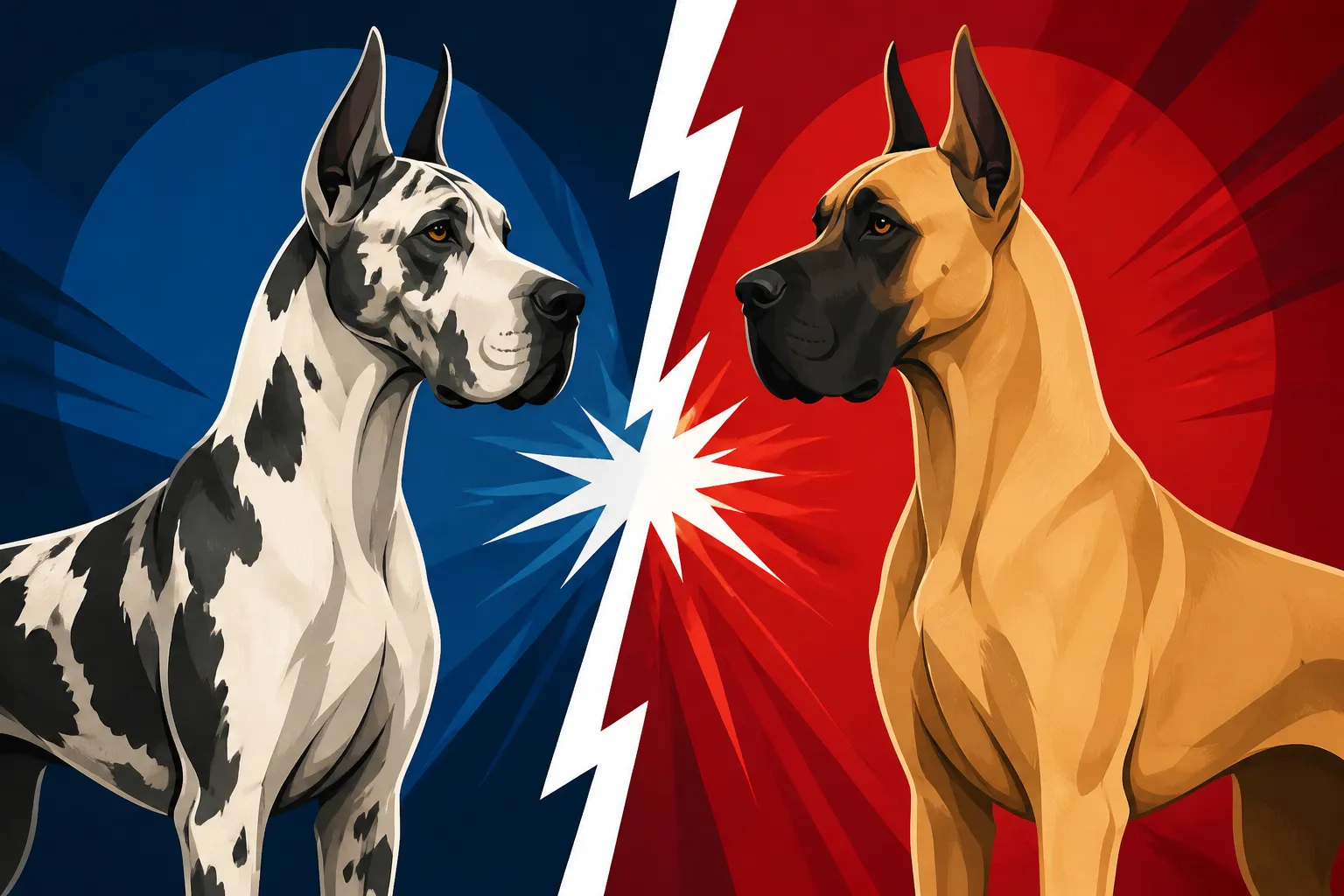
A “European Great Dane” usually means a Dane bred in Europe, descended from European lines, or simply described as having a heavier, more substantial appearance. “American Great Dane” commonly refers to a dog bred in the United States, often within lines selected to meet the American Kennel Club standard. These phrases are useful shorthand, but they do not define two distinct breeds with a fixed set of traits.
There is also more than one kennel-club standard in use. A breeder may describe their dogs according to the standard used in their country, and breeders in the same country may emphasize different qualities. A dog’s appearance can reflect its ancestry, its parents, the breeder’s goals, and ordinary individual variation—not just the side of the Atlantic where it was born.
That distinction matters if you are comparing puppies online. A label such as “European” does not guarantee a particular height, weight, temperament, or level of health. Likewise, “American” does not automatically mean a dog will be lighter, healthier, or easier to live with. Ask about the specific parents and the breeder’s priorities rather than treating a regional label as a promise.
Standards shape the look, but do not tell the whole story
Breed standards describe the structure and movement that a dog should have in the show ring. The standards used in different countries can vary in wording and emphasis, so a breeder aiming for one country’s show goals may produce dogs that look somewhat different from dogs bred toward another standard. That helps explain why some people associate European lines with more substance and American lines with a more athletic outline.
But a standard is not a complete description of every dog. Great Danes from the same litter may differ in bone, head shape, height, expression, and movement. A show prospect, a companion dog, and a dog bred primarily for a particular style of conformation may also have different strengths. For a closer look at the breed’s overall proportions, see The Great Dane the Show Ring Is Looking For and How Big a Great Dane Actually Gets.
It is more accurate to think of “European” and “American” as broad descriptions than as reliable predictions. A well-bred Dane can be athletic or substantial in either country, and a dog’s quality cannot be judged from a label or a photograph alone.
How the Two Types May Look Different
Build and overall impression
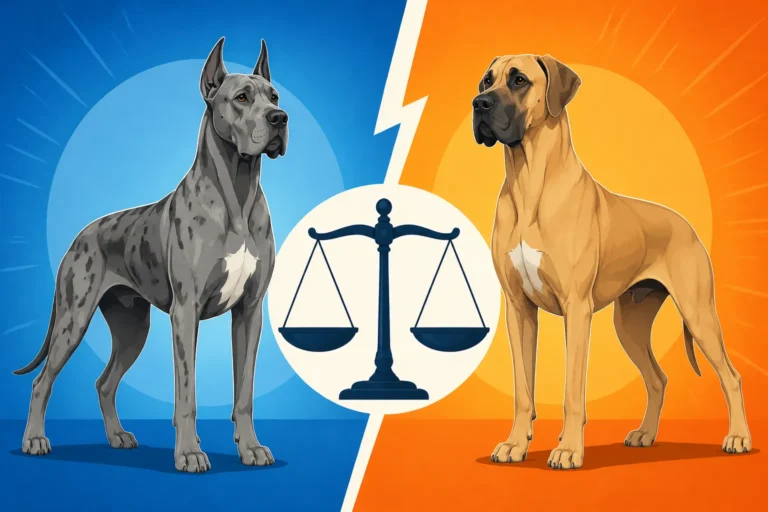
People often describe European-line Great Danes as heavier-boned, broader, or more mastiff-like, while American-line dogs are sometimes described as taller-looking, narrower, or more refined. These are general impressions, not rules. There are European-bred dogs with a lighter outline and American-bred dogs with plenty of bone and substance.
A photo can exaggerate the difference. Camera angle, posture, the dog’s age, its condition, and even how it is standing can make one Dane appear much taller or heavier than another. A young dog may also look leggier before the rest of its body fills out. If you are evaluating a breeder’s dogs, try to see several adults from their lines in person or in unposed video, not just a single carefully selected image.
When assessing build, consider whether the dog moves comfortably and appears balanced—not simply whether it looks massive. Great Dane size is already imposing, and extra bulk is not automatically a sign of better structure or health. The breed’s broad range of body types is easier to understand alongside Great Danes Against the Other Giant Breeds.
Head, chest, and coat color
Head shape and chest depth are among the features that can contribute to the impression of a more substantial or refined dog. Yet there is no single “European head” or “American chest” that applies to every Dane. Compare individual dogs in profile and from the front, and look for proportion and comfortable movement rather than focusing on one feature in isolation.
Color is another area where assumptions can creep in. A dog’s coat color does not tell you whether it is European or American, and popular color labels are not proof of pedigree quality. If you are considering a particular color, learn how it fits within the breed and ask whether the breeder makes health and temperament a priority alongside appearance. The Seven Great Dane Colors offers more context on coat-color categories.
Be cautious if a seller leans heavily on phrases such as “rare European color” or suggests that a certain look guarantees a superior dog. A striking appearance may catch your eye, but it is only one part of the decision. Sound structure, good care, suitable temperament, and responsible breeding deserve at least as much attention.
| Feature people compare | Often associated with European lines | Often associated with American lines | What to remember |
|---|---|---|---|
| Overall build | More substantial or heavier-boned | More refined or athletic-looking | Individuals vary; neither description is guaranteed |
| Head and chest | Sometimes described as broader | Sometimes described as less massive | Look for balance and comfort, not a label |
| Height and weight | Sometimes assumed to be larger | Sometimes assumed to be lighter | Ask about actual adult dogs in the line |
| Coat color | No reliable regional distinction | No reliable regional distinction | Color does not establish lineage or quality |
| Temperament | No dependable regional rule | No dependable regional rule | Evaluate the individual dog and its upbringing |
| Health | No regional label guarantees health | No regional label guarantees health | Ask for relevant health records and testing |
Temperament, Health, and Everyday Life
A label does not predict personality
Great Danes are often described as gentle companions, but personality depends on the individual dog, inherited traits, early experiences, socialization, training, and the environment they live in. A European-line dog is not automatically calmer or more protective, and an American-line dog is not automatically more energetic or easier to train.
Think about the dog in ordinary situations: greeting visitors, walking on a leash, settling when the household is busy, and sharing space with children or other pets. With a giant dog, even friendly excitement can be difficult to manage if the dog has not learned polite manners while young. Read The Gentle Great Dane Temperament and Its Limits for a useful perspective on the difference between a generally affectionate breed and an individual dog’s behavior.
A breeder should be willing to talk about the temperaments they see in their adults and what they do to raise confident, well-socialized puppies. Ask how the dogs respond to handling, everyday household noises, unfamiliar people, and routine veterinary care. The answers will tell you more than a regional label.
Health questions matter more than line-name claims
No line or country of origin guarantees a healthy dog. Great Danes can face health concerns that deserve thoughtful attention, and responsible breeders should be open about the health of their breeding dogs and their relatives. Ask what testing has been completed, what the results mean, and whether you can review the relevant documentation. A vague assurance that the parents are “healthy” is not a substitute for clear records.
It is also worth asking how the breeder approaches growth, body condition, and exercise for puppies. Giant-breed puppies need careful, age-appropriate care, and a breeder should be able to explain how they support steady growth rather than encouraging a puppy to become oversized as quickly as possible. For a more detailed checklist, see The Health Testing a Great Dane Breeder Owes You and Great Dane Hips, Elbows and Growing Joints.
If a breeder presents “European blood” or “American blood” as a guarantee against health problems, treat that claim cautiously. Ask about health testing and family history directly. A responsible conversation should focus on evidence, known risks, and how the breeder makes decisions—not on a promise that a particular type is immune to inherited conditions.
Plan for the dog in front of you
Whether your Dane is heavier or more refined, daily life revolves around the dog’s actual size and needs. Consider space to move around furniture, safe footing on slippery floors, a vehicle the dog can enter comfortably, and a resting place large enough for an adult to stretch out. A household that can manage one type of Dane may find another individual’s size, strength, or activity level a different fit.
Before buying equipment, measure the dog and check the manufacturer’s dimensions rather than shopping by breed label alone. Retailers such as Chewy may list beds, harnesses, and bowls in different size ranges, but the listed measurements still need to match your particular dog. A bed that seems generous for a “large breed” may be too short for a fully stretched Dane.
The same applies to food storage, travel gear, and everyday supplies. Chewy can be one place owners browse for oversized essentials, but product descriptions and measurements matter more than whether an item is marketed for a European or American Dane. For the broader question of household fit, see Whether a Great Dane Suits Your House. If you are preparing a home, choosing equipment based on your dog’s real measurements is more reliable than buying for a type label.
Choosing a Great Dane Without Getting Stuck on the Label
Questions to ask a breeder
Start by asking what the breeder means when they call their dogs European or American. Do they mean where the dogs were bred, what registry or standard they follow, or a particular appearance? A clear answer helps you understand whether the word describes ancestry, breeding goals, or simply marketing language.
Then ask about adult dogs from the same lines. How large are they, how do they move, and what are their temperaments like at home? Ask to meet the dam if possible, and ask about the sire’s behavior and health information if he is not on site. A breeder should be comfortable discussing both the appealing qualities and the limitations they see in their dogs.
Finally, ask for health documentation, information about how puppies are raised, and guidance for the first months at home. Do not let urgency, a dramatic size claim, or a “rare” label rush you into a decision. The right breeder should be interested in whether your home and expectations fit the puppy—not only in making a sale.
A practical way to compare individual dogs
If you are comparing two puppies or breeders, write down what matters most to your household before you visit. You might prioritize a steady temperament, a comfortable adult size, a certain energy level, or a breeder who is especially thorough about health records. That makes it easier to compare dogs on meaningful criteria instead of being swayed by whichever puppy looks biggest in a photo.
When you meet the dogs, observe how they recover from ordinary surprises and how they interact with people. Ask to see them move naturally, rather than judging only from a posed stance. A calm greeting, curious exploration, or willingness to settle can offer useful clues, although puppy behavior is not a guarantee of adult personality.
For supply planning, keep the same practical approach. Chewy and other retailers may help you find large-dog products, but confirm dimensions, fit, and suitability for your dog’s age and needs. A young Dane’s equipment may need to be replaced as the dog grows, so avoid assuming that a product described for a particular line will fit every dog of that type.
The most useful takeaway
“European” and “American” can help describe broad breeding backgrounds and common style preferences, but they are not dependable shortcuts for choosing a Great Dane. There is overlap between the looks associated with each label, and individual dogs do not always match the stereotype. Neither label, by itself, tells you how large a dog will become, whether it will be easy to live with, or whether it has been carefully bred.
Focus on the dog’s parents, health records, structure, temperament, and the breeder’s transparency. Consider what kind of giant dog your household can manage, and make plans for the specific puppy or adult you are meeting. That approach will serve you better than choosing based on a regional label alone.
Disclaimer
This article is for general informational purposes only and does not constitute professional advice. Laws, prices and regulations vary by location and change over time. Consult a qualified professional for guidance on your specific situation.