Teaching a Great Dane to Leave Food Alone
It's a scene many Great Dane owners know all too well: you turn your back for a split second, and suddenly, that delicious sandwich or carefully prepared meal has vanished from the counter, disappearing into the cavernous maw of your giant companion. It's frustrating, potentially dangerous for your dog, and can feel like an endless battle against an impossibly tall, food-motivated thief. This guide is here to walk you through understanding why your Great Dane engages in counter-surfing and, more importantly, how to teach them to leave food alone, giving you back control of your kitchen and peace of mind.
Understanding Why Your Great Dane Becomes a Counter Surfer
It’s easy to feel personally offended when your Great Dane helps themselves to a snack you were looking forward to. We often interpret it as defiance or bad manners, but in reality, their behavior is usually driven by a combination of instinct, opportunity, and sheer physical advantage. Understanding this isn't about excusing the behavior, but about figuring out the root cause so we can address it effectively.
The Reach and the Reward: A Great Dane's Natural Advantage
Let's be honest, Great Danes are built for this kind of "foraging." Their incredible height, especially when standing on their hind legs, puts many kitchen counters and even some dining tables well within their reach. With a long neck and an impressive snout, they don’t even need to fully stand up to sweep a plate clean. They learn very quickly that if something smells good, and it's there, it's fair game.
Imagine the perspective from down below. They smell something tantalizing, something far more interesting than their usual kibble. They might initially just sniff, then perhaps a tentative lick. If no one intervenes and they manage to grab a morsel, even a tiny one, that instant gratification is a huge reward. This single "win" can be enough to solidify the behavior in their minds. They’ve successfully raided the buffet, and now they know how to do it again. It's not unlike a child learning they can sneak a cookie from the jar; if it works once, why wouldn't they try it again?
Opportunistic Eating: It's Not Malice, It's Instinct
While it might feel like your Great Dane is deliberately trying to annoy you, their counter-surfing behavior stems more from an innate, opportunistic drive than any form of malice. Dogs, by nature, are scavengers. In the wild, finding food means survival, and missing an opportunity to eat could mean going hungry. Your kitchen counter, to them, is just another potential foraging ground, especially if it's been successful in the past.
They aren't sitting there plotting how to get that roast chicken. Instead, they're reacting to the sensory input: the alluring scent, the visual availability. If they're a younger Great Dane, still exploring the world with their mouth and nose, every new scent is an invitation. For an older dog, it might be a learned habit that's become ingrained. The key is to remember they are dogs, driven by primal instincts, and it's our job as their guardians to guide those instincts into acceptable behaviors within our human homes. They simply don't have the same concept of "mine" when it comes to unattended food that we do.
Setting Up for Success: Management and Prevention
Before you even start formal training, the absolute best defense against counter surfing is a good offense: proactive management. If your Great Dane never has the opportunity to steal food, they can't practice the behavior, and therefore, they can't be rewarded for it. This might sound overly simple, but for a dog as large and determined as a Great Dane, removing the temptation is often half the battle.
The Golden Rule: Nothing Within Reach, Nothing to Steal
This is perhaps the most crucial piece of advice for any Great Dane owner dealing with counter-surfing: if it's not there, they can't get it. This means developing a hyper-vigilant habit of clearing counters, pushing food far back, or better yet, putting it away entirely. Think of your kitchen as a perpetually "dog-proofed" zone whenever you're not actively present and supervising.
Consider what a Great Dane can reach. It's not just the front edge of the counter; a dog their height can often stretch deeply onto surfaces. Hot pans, sharp knives, tempting platters of food – all should be immediately moved to a secure pantry, refrigerator, or high cupboard. Even cooling baked goods on a rack need to be in an enclosed space where your Dane can't access them. This might mean investing in taller shelving or pantry organization solutions. The moment your Great Dane successfully sniffs out and consumes something from a forbidden area, that memory reinforces the behavior, making your training efforts much harder. Baby-Proofing a Kitchen From a Great Dane goes into more detail about securing your space.
Controlled Feeding and Structured Mealtimes
Another vital aspect of prevention is establishing a clear, consistent feeding routine. Great Danes thrive on predictability, and knowing when and where their food comes from can reduce their inclination to scavenge. Free-feeding, where food is left out all day, can inadvertently encourage opportunistic eating because the dog never learns that food only appears at specific times in specific places.
Instead, feed your Great Dane two or three times a day at set hours. This helps regulate their hunger and associates food with their bowl, not with random opportunities on the counter. Make mealtime a calm, positive experience. After they finish eating, pick up the bowl. This teaches them that food is available, but on your terms and schedule. It's also critical for managing health concerns unique to the breed; Meal Habits That Cut a Great Dane's Twist Risk emphasizes the importance of splitting meals for digestive health. A structured feeding schedule helps them understand that they don't need to find food elsewhere, because their needs will be met consistently.
Foundation Training: The "Leave It" Command
While management is essential, truly solving the counter-surfing issue requires teaching your Great Dane a reliable "Leave It" command. This command is a game-changer, giving you a powerful tool to redirect their attention and prevent them from engaging with tempting items, both in the home and out in the world. Patience and consistency are your best friends here.
Starting Small: Teaching "Leave It" on the Floor
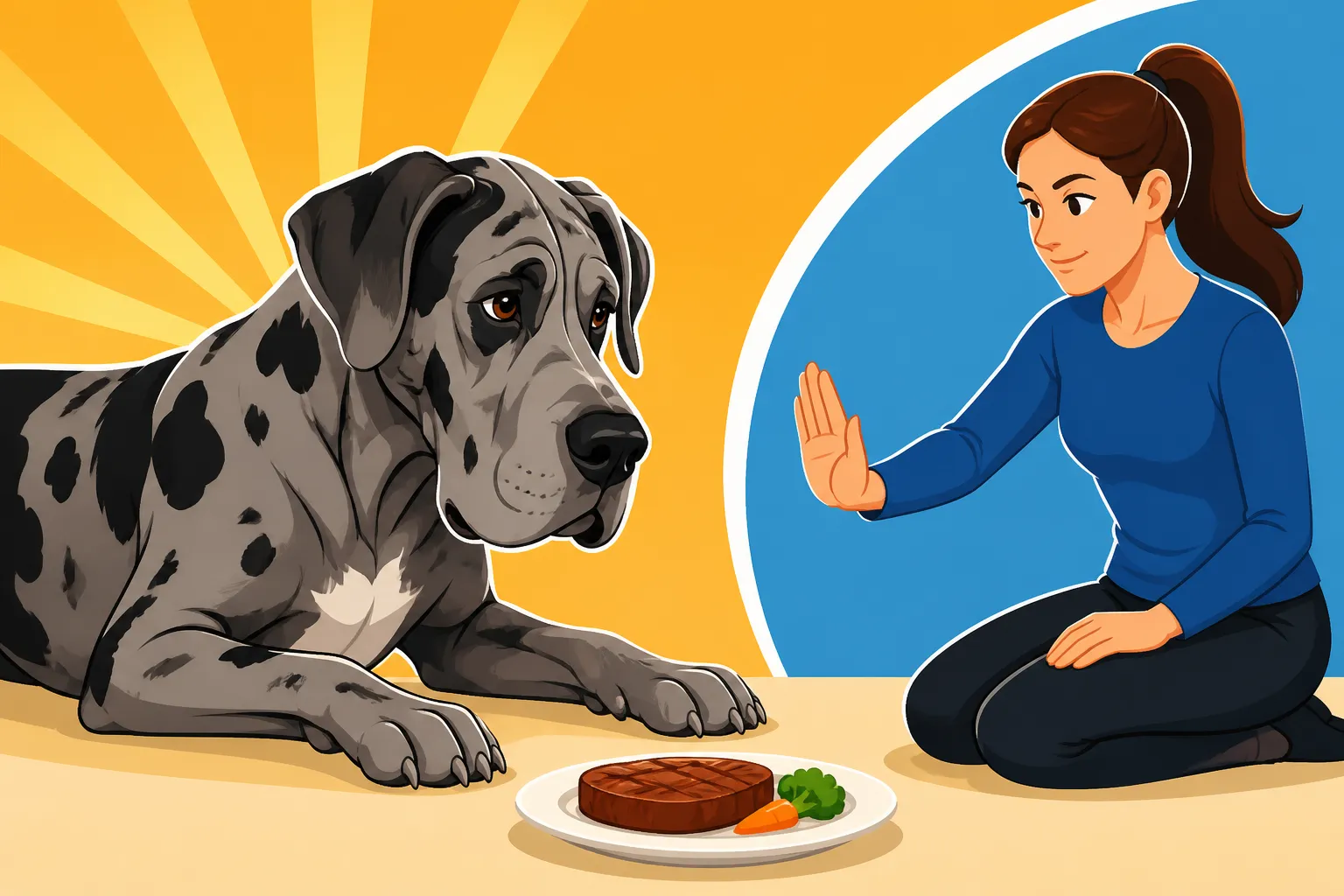
You wouldn't expect your Great Dane to resist a perfectly grilled steak on the counter the first time you say "Leave It." Training this command needs to start small, in a low-distraction environment, with low-value treats. Begin with your dog on a leash or in a confined space where they can't easily bolt. Hold a less exciting treat (like a piece of their kibble) in a closed fist. When your dog tries to sniff or lick your hand, keep it closed. The moment they back away, even slightly, or look at you, say "Yes!" or click a clicker, then immediately reward them with a different, higher-value treat from your other hand.
Repeat this many, many times. The goal is for them to associate "Leave It" (or the closed fist cue) with the idea that ignoring the initial temptation leads to a better reward. Once they consistently back away from your closed fist, try placing the low-value treat on the floor and covering it with your hand. Gradually, move to uncovered treats on the floor, always ready to cover it if they lunge. Only reward them for ignoring the target item and looking to you. Treats a Great Dane Will Work For can give you ideas for those high-value rewards to keep your Dane motivated. The key here is not just getting them to not take the item, but to make the choice to disengage from it.
Graduating to Higher Stakes: Counters and Tables
Once your Great Dane has mastered "Leave It" on the floor with various levels of distraction, it's time to generalize the skill to the actual problem areas: counters and tables. This is where many owners get tripped up, expecting too much too soon. Start by placing a low-value, non-tempting item (like a piece of dry toast, not a steak) on the very back of the counter, while your dog is on a leash and you are actively supervising.
Stand between your dog and the counter. If they even look at the item, give your "Leave It" command. If they disengage and look at you, reward them immediately with a high-value treat from your hand (never from the counter item!). If they attempt to reach, gently redirect them with the leash and try again. Gradually increase the value of the item on the counter and shorten the distance, always ensuring you're setting them up for success, not failure. Never let them succeed in stealing. The training needs to be meticulously staged, moving from easy wins to more challenging scenarios. Remember that a Great Dane's reach is considerable, so be prepared to physically block them if necessary while they're learning. Why a Great Dane Reaches the Kitchen Counter might help you visualize their capabilities.
Addressing Counter Surfing Directly
Even with excellent management and foundation training, you might still encounter situations where your Great Dane tries to test the boundaries. This is where direct intervention techniques come into play, designed to interrupt the behavior and reinforce the "Leave It" command in real-time.
The "Invisible Leash" and Redirection
For active training or during times when you know tempting food might be out (like during meal prep), consider using an "invisible leash." This isn't actually invisible; it's a lightweight leash (like a thin nylon lead) kept on your Great Dane and either held by you or dragging on the floor under your constant supervision. This allows for immediate, gentle correction without having to physically grab your giant dog.
If your Dane makes a move for the counter, a slight, gentle tug on the leash combined with a firm "Leave It!" can interrupt the action. The moment they disengage and look at you, reward them with praise and a treat from your hand, away from the counter. Consistency is key. Every time they try to counter surf, they should be redirected and rewarded for choosing not to. You're teaching them that engaging with you when food is present is more rewarding than engaging with the forbidden food itself. This method helps manage their impressive strength; Leashes Rated for a Great Dane can help you choose the right equipment.
Environmental Management Tools
Sometimes, direct training isn't enough, or you need an extra layer of prevention when you can't be actively supervising every second. There are environmental management tools that can create negative associations with counter-surfing, effectively making the act less appealing. These should be used with caution and never in a way that truly frightens or harms your dog, but rather to create a mild deterrent.
One option could be motion-activated alarms or air cans. Placed discreetly on the counter, these emit a sudden, startling sound or burst of air when triggered, often enough to make your Great Dane jump back. The key is that the deterrent comes from the environment, not from you, so your dog doesn't associate you with the unpleasant surprise. Over time, they learn that approaching the counter sometimes leads to this startling event, making them less likely to try. You can find various versions of these on Amazon. Another consideration, though less about deterrents, is securing your food storage. Investing in heavy, dog-proof trash cans or securing pantry doors can prevent successful raids. Bins a Great Dane Cannot Open provides practical solutions for this specific challenge, ensuring even the cleverest Dane can't get into trouble.
| Method | Pros | Cons | Best Used For |
|---|---|---|---|
| Strict Management | Highly effective, immediate results, safe for dog | Requires constant vigilance, doesn't teach an alternative behavior | Preventing initial habit formation, unsupervised periods |
| "Leave It" Training | Teaches valuable life skill, positive reinforcement | Requires patience and consistency, takes time to generalize to high-value items | Building foundation obedience, supervised prevention |
| "Invisible Leash" | Provides control and immediate redirection, prevents successful theft | Requires active handler participation, dog must be leashed | Active training sessions, high-temptation environments with supervision |
| Environmental Deterrents | Creates self-correction (dog associates counter with deterrent) | Can be startling to dog, might accidentally trigger on people, risk of creating fear association | Unsupervised prevention (short periods), breaking an established habit |
| Secure Storage | Completely eliminates opportunity, safe, passive | Requires changes to home organization, may not address all food sources | Long-term prevention, securing trash, pantry, and food prep items |
Consistency and Patience: The Long Game with a Large Breed
Training a Great Dane, especially one with an established bad habit, is never a quick fix. Their size and intelligence mean that they will test boundaries, and they remember what works. This is why consistency is paramount, not just from you, but from everyone in your household.
The Entire Family Needs to Be on Board
Imagine you've spent weeks diligently training "Leave It" and consistently clearing counters. Then, a family member, perhaps a child or a guest, leaves a plate of cookies unattended on the coffee table for just a moment. Your Great Dane, sensing the opportunity, makes a successful grab. All your hard work can feel undone in an instant because that single successful theft provides a massive reward, reinforcing the very behavior you're trying to extinguish.
This is why everyone who interacts with your Great Dane must understand and adhere to the rules. Hold a family meeting. Explain the training plan, the importance of clearing surfaces, and how to correctly respond if the dog attempts to counter surf. Children, in particular, need clear guidelines on not feeding the dog from the table or leaving their snacks within reach. It's a team effort, and any weak link can compromise progress. Discussing Teaching Children to Move Around a Great Dane might also highlight the importance of consistent rules for safety and behavior. Remember, your Great Dane learns from all interactions, not just the ones you intentionally set up as training sessions.
Professional Help When You Need It
Sometimes, despite your best efforts, a behavior can feel entrenched, or you might be struggling to find the right approach. There's absolutely no shame in seeking professional help. In fact, for a large and powerful breed like a Great Dane, addressing behavioral issues effectively is crucial for both their safety and your peace of mind. A certified professional dog trainer or a veterinary behaviorist can offer tailored strategies, hands-on guidance, and a fresh perspective on your specific situation.
They can help identify any subtle cues you might be missing, refine your training techniques, and introduce advanced methods if necessary. Look for trainers who have experience with giant breeds, as managing a 150-pound dog requires specific skills and approaches. Resources like the Certification Council for Professional Dog Trainers (CCPDT) or the Association of Professional Dog Trainers (APDT) can help you find qualified professionals in your area. Don't let frustration build to the point of resentment; a good trainer can make a world of difference. For more on finding the right help, check out Finding a Trainer Comfortable With a Great Dane.
Reinforcing Good Habits Beyond the Kitchen
While focusing on the kitchen is critical, managing your Great Dane's behavior around food extends to their overall enrichment and mental state. A bored, under-stimulated Great Dane is often a creative, mischievous Great Dane. Providing appropriate outlets for their energy and intelligence can significantly reduce undesirable behaviors like counter-surfing.
Chew Toys and Puzzle Feeders for Mental Stimulation
Great Danes are often described as "gentle giants," but they are still dogs with natural urges to chew, forage, and problem-solve. When they lack appropriate outlets for these drives, they might turn to less desirable activities, like exploring forbidden kitchen surfaces. Investing in a variety of durable chew toys and puzzle feeders is a fantastic way to keep their minds engaged and their mouths busy.
Look for extra-large, tough toys designed for powerful chewers. Brands like Kong and Nylabone offer heavy-duty options that can stand up to a Great Dane's jaws. Puzzle feeders, which require your dog to manipulate them to release treats, are particularly effective. They satisfy their natural foraging instincts in a productive way, making them "work" for their food or treats. You can stuff these with wet food, peanut butter, or kibble, and freeze them for a longer-lasting challenge. Amazon offers a wide selection of these products. These tools not only keep them occupied but also build their confidence and problem-solving skills. Puzzle Feeders a Great Dane Cannot Crush has some excellent recommendations for durable options.
Regular Exercise and Enrichment
A tired Great Dane is usually a well-behaved Great Dane. While they aren't necessarily hyperactive dogs, they do need regular, appropriate exercise to stay physically and mentally healthy. This doesn't mean forced, long-distance runs (which can be detrimental to their joints, especially when young), but rather consistent walks, supervised playtime in a secure yard, and opportunities for mental engagement.
Daily walks, playing fetch in a large, fenced area, or even short training sessions that challenge their minds can make a huge difference. An under-exercised or under-stimulated Great Dane is more likely to be bored, restless, and therefore, more prone to seeking out trouble, including counter-surfing. Think about how a restless child might get into mischief; a Great Dane is no different. Tailor their exercise to their age and physical condition. For guidance on appropriate activity levels, especially for growing dogs, consider Wearing Out a Great Dane Without Wrecking Its Joints. By meeting their needs for activity and enrichment, you're building a foundation for a well-adjusted dog less inclined to create their own "fun" in your kitchen.
Disclaimer
This article is for general informational purposes only and does not constitute professional advice. Laws, prices and regulations vary by location and change over time. Consult a qualified professional for guidance on your specific situation.