Why a Great Dane Steals Food Off Counters
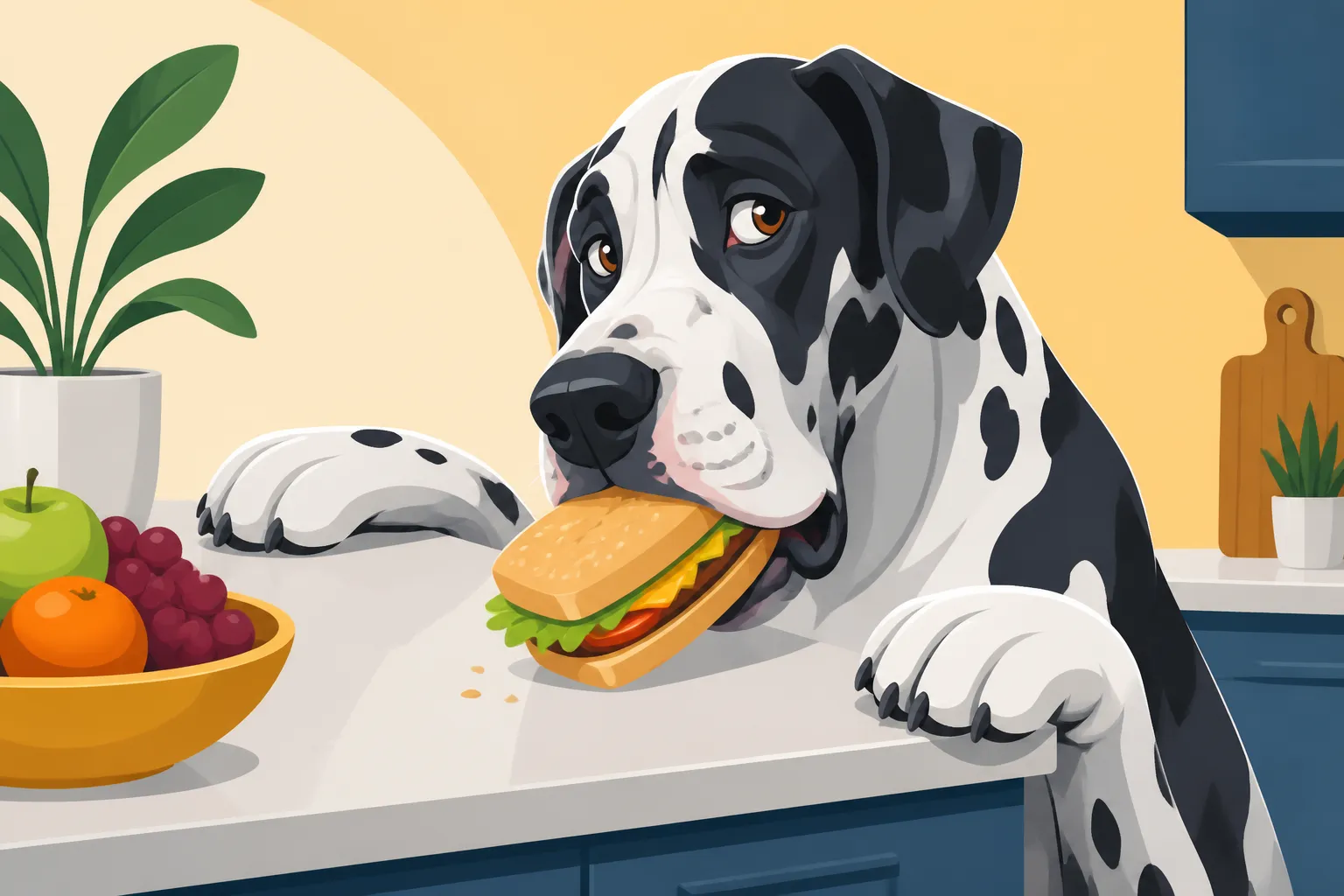
It’s a scenario many Great Dane owners know all too well: you turn your back for a moment, perhaps to grab a forgotten ingredient from the pantry, only to return and find your colossal canine companion’s head buried deep in the forbidden fruit (or roast, or loaf of bread) that was just moments ago sitting safely on the kitchen counter. This infuriating, and often quite costly, habit of counter-surfing isn't just rude; it's a genuine safety hazard for our gentle giants. This guide will dive deep into why your Great Dane might be eyeing your countertops like a buffet and, more importantly, how to put a stop to this culinary crime spree.
The Anatomy of a Counter-Surfing Great Dane
When you're dealing with a dog the size of a small pony, the rules of engagement for "keep off the counters" are entirely different than with a Chihuahua. It’s not just about desire; it's about sheer physical capability.
The Unmatched Reach and Leverage
Let's be brutally honest: most kitchen counters are designed for human height. For a Great Dane, standing on all fours, many counters are already within comfortable sniffing distance. But the real game-changer is when they decide to stand up. A full-grown male Great Dane can easily reach over 30 inches at the shoulder, meaning when they stretch up, their nose can be well over five feet off the ground. That’s higher than many people's heads!
This isn't just about reaching with their snout, either. Their strong, sturdy paws, often compared to dinner plates, can be used to brace themselves against the counter edge or even sweep items off if they're particularly adept. Imagine a graceful, yet determined, creature weighing over 100 pounds using its entire body weight to leverage itself up and over a barrier. They don't just "steal" food; they execute a full-scale culinary heist. A delicate pastry left too close to the edge becomes a low-hanging fruit for a Great Dane. They can easily knock over cooling racks, slide cutting boards, or even nudge open cupboard doors that aren't securely latched. Their size isn't just impressive; it's a formidable tool in their quest for counter-treasures.
A Superior Sense of Smell
While their height gives them access, their nose is the ultimate guide. Dogs, in general, have an incredible sense of smell, far surpassing ours. A Great Dane's olfactory senses are no exception. Even if you've done a stellar job of cleaning up visible crumbs, the lingering aroma of that roast chicken you cooked last night, or the subtle scent of warm cookies cooling on a wire rack, is an irresistible beacon for a hungry Dane.
Think about it from their perspective: you might not smell the faint residual grease on the stovetop or the evaporating steam from a freshly brewed cup of tea. But your Great Dane's nose picks up every molecular whisper. They can trace the scent of a dropped crumb to its origin on the counter, then use their height to investigate. What to us is a clean surface, to them is a rich tapestry of delicious, ghost-like aromas, promising a potential reward. They don't just sniff; they investigate with a dedication that would make a detective proud. This powerful sense of smell, combined with their imposing stature, makes them incredibly efficient at locating and acquiring any unattended food item that crosses their path.
Understanding the Drive: Why Great Danes Are Food Motivated
It’s easy to get frustrated and think your Great Dane is just being naughty, but often, their behavior stems from deep-seated instincts and learned associations.
The Instinctual Scavenger
Great Danes, like all dogs, are descended from opportunistic scavengers. In the wild, food sources were never guaranteed, and eating whatever was available, whenever it was available, was crucial for survival. While our pampered Danes don't face such stark realities, that primal drive to find and consume food remains. Their sheer size also plays a role: a Great Dane needs a substantial amount of calories to maintain its impressive physique. Feeding an Adult Great Dane Six to Ten Cups is a regular commitment, and their bodies are naturally geared to seek out sustenance.
This means that a "free" meal, even if it's technically stolen, feels like a jackpot. It bypasses the waiting, the polite requests, and the measured portions of their regular bowl. It's a primal satisfaction of finding a resource and claiming it. This isn't necessarily about being genuinely hungry in the moment, but about that underlying instinct to capitalize on any feeding opportunity. They aren't thinking about being "bad"; they're thinking about fulfilling a very basic, very strong biological urge. We, as humans, often project our understanding of manners and rules onto our dogs, forgetting that their world is often driven by instinct and immediate gratification.
Positive Reinforcement Accidental or Otherwise
This is perhaps the most critical factor in why counter-surfing persists. Every single time your Great Dane successfully snags a treat from the counter, they receive powerful positive reinforcement. Even if it's just a tiny crumb, that reward solidifies the behavior. They think, "Hey, that worked! I got food!"
The problem is that this reinforcement doesn't have to happen every time for the behavior to continue. Intermittent reinforcement – where the dog sometimes gets a reward and sometimes doesn't – actually makes a behavior harder to extinguish. It's like a slot machine; you don't win every time, but the occasional big payout keeps you pulling the lever. So, if your Dane manages to snatch a forgotten sandwich once a week, or even once a month, that's enough to keep the hope alive and the counter-surfing attempts going strong. The frustration we feel when we find our butter dish licked clean is overshadowed by the dog's profound satisfaction from their culinary conquest. It's a classic case of us accidentally training them to do exactly what we don't want.
The Intelligence Factor: Danes Are Smarter Than They Look (Sometimes)
Don’t let their goofy charm fool you; Great Danes are intelligent dogs. They learn, they observe, and they problem-solve, especially when food is involved.
Problem-Solving for a Snack
You might be surprised at the ingenuity your Great Dane displays when motivated by food. They can learn to push chairs over to gain extra height, open unlatched pantry doors with their nose, or even delicately slide items closer to the edge with their tongue. I've known Danes who learned to open childproof latches on cabinets, not by brute force, but by clever manipulation with their powerful jaws and nimble tongues. They watch you. They see how you open the fridge, how you store treats, and where you place the most tempting items.
Consider the hypothetical: you leave a plate of cooling cookies on the counter. Your Dane, seeing no one around, might first try jumping. When that doesn't work, they might nose at the edge, realizing they can shift the plate. If it moves closer, they've solved a piece of the puzzle. Next, they might try to swipe it with a paw or nudge it with their head. Each successful movement, no matter how small, brings them closer to their goal and teaches them a new strategy. They are, in essence, canine engineers, constantly looking for the simplest, most effective way to reach their objective. This problem-solving ability, coupled with their sheer strength, makes them formidable opponents in the battle against counter-surfing.
Learning by Association
Great Danes are masters of association. They quickly connect certain sounds, smells, and routines with the imminent possibility of food. The crinkle of a chip bag, the opening of the refrigerator door, the sound of the oven timer, or the clatter of pots and pans – these are all cues that signal "food is coming!" or "food is present!"
They also associate your movements. If you always leave the room after setting out dinner ingredients, they'll learn that your departure is their cue for investigation. They might even wait patiently for you to leave before making their move, demonstrating a surprising level of cunning. This learned association can also extend to certain times of day, or even specific days of the week, if your routine is predictable. For example, if Sunday morning always means bacon, they'll be extra vigilant around the kitchen during those hours. This keen observational skill means they're constantly processing information about their environment, using it to predict opportunities for a snack.
Common Counter-Surfing Triggers and Scenarios
Knowing when your Great Dane is most likely to strike can help you prevent the behavior before it even starts.
The "Opportunistic Thief" Scenario
This is the most common scenario: unattended food. It's the cooling roast chicken, the freshly baked bread, the plate of cookies, or even just dirty dishes left too close to the edge of the sink or counter. We've all been there – multitasking in the kitchen, turning our back for a split second, and poof, the entire meal disappears. This is especially true when distractions are high, like during a party or holiday gathering. With so many people moving around, loud conversations, and different smells, it's easy for your Dane to slip in unnoticed and snatch a prize.
Their height also means that what's eye-level for you is often nose-level for them. A casual lean against the counter, a quick stretch, and suddenly, they're exploring a whole new world of forbidden delights. This isn't always about malicious intent; sometimes it's simply an irresistible opportunity presenting itself to a creature whose instincts tell them to seize it. The counter, for them, isn't a boundary, but a landscape to be explored. It’s a constant battle of wits and vigilance, particularly when delectable smells fill the air and your attention is divided.
Boredom and Lack of Mental Stimulation
A bored Great Dane is a busy Great Dane, and often, that business involves finding something to do with their mouth – which frequently leads them to your countertops. These intelligent dogs need mental stimulation just as much as they need physical exercise. If they're left alone for long stretches without engaging toys, puzzle feeders, or training sessions, they'll find their own entertainment. And what's more entertaining than investigating interesting smells and potentially scoring a delicious snack?
Counter-surfing, for a bored Dane, can become a thrilling game, a way to alleviate the monotony of an empty house or a quiet afternoon. The act of scouting, reaching, and potentially snatching is stimulating in itself. Instead of channeling their energy into appropriate outlets like a good long walk or a challenging puzzle toy, they focus their considerable intellect on kitchen raids. Wearing Out a Great Dane Without Wrecking Its Joints is crucial for their physical health, but mental exercise is just as vital for their behavior. Providing ample mental enrichment can redirect this exploratory drive away from your dinner plans.
Hunger and Inadequate Nutrition
While most Great Danes are incredibly well-fed, their immense size means they have gargantuan appetites and significant caloric requirements. Sometimes, despite regular meals, a Great Dane might feel perpetually hungry, especially if their diet isn't quite meeting their needs, or if they're still growing and burning through calories at an incredible rate. Whether Six Cups Is Enough for a Great Dane depends entirely on the individual dog's activity level, age, and metabolism.
If your Dane is genuinely underfed or on a diet that isn't satiating them, their drive to find extra food will be even stronger. It’s important to differentiate between genuine hunger and opportunistic greed, though the line can be blurry with a dog that loves food. Consult with your vet to ensure your Dane is on an appropriate diet for their age and activity level. However, even a perfectly fed Dane can be an opportunistic eater. The allure of a different texture or flavor from the counter can be too strong to resist, even if their stomach is full. It's a treat, a bonus, and a deviation from the usual kibble.
Strategies to Deter Counter-Surfing (The How-To)
Now that we understand why they do it, let's talk about how to stop it. This isn't a quick fix; it requires consistency, management, and training.
Management: Prevention is Key
The single most effective strategy against counter-surfing is impeccable management. Simply put: if there's no food on the counter, there's nothing for your Great Dane to steal. This might sound simplistic, but it's the golden rule. It means adopting a new kitchen routine where counters are always clear when you're not actively supervising. Plates of cooling food should be moved to a secure pantry, a high shelf, or placed behind a baby gate (more on that in a moment). Dirty dishes go directly into the dishwasher or sink, out of reach.
For times when you absolutely cannot supervise, consider crude but effective deterrents. A stack of empty soda cans balanced precariously, a cookie sheet teetering on the edge, or even motion-activated alarms designed for pets can create a startling, unpleasant experience that discourages future attempts without you having to be present. You can find various options for these on Amazon, from simple motion sensors to more elaborate spray devices. Additionally, using physical barriers like large, sturdy baby gates or crating your Great Dane when you're out or unable to supervise is incredibly effective. Make sure to choose gates that are tall and strong enough to withstand a Great Dane's determination. Baby Gates a Great Dane Cannot Step Over are essential for these massive dogs. Remember, every time they succeed, the behavior is reinforced, so preventing success is paramount.
Training: Teaching "Leave It" and "Off"
Alongside management, consistent training is crucial. The "Leave It" command is your best friend here. Start by teaching "Leave It" with low-value items on the floor, gradually increasing the temptation and moving to higher surfaces. You want your Great Dane to understand that "Leave It" means don't touch that item, regardless of how delicious it smells. Reward them generously with a high-value treat from your hand when they successfully ignore the tempting item.
The "Off" command is equally important. This teaches them to remove their paws (or entire body) from a surface. Practice this by luring them off the counter with a treat, saying "Off," and then rewarding them once all four paws are on the floor. Consistency is absolutely vital. Everyone in the household must use these commands the same way, every time. Teaching a Great Dane to Leave Food Alone takes time and patience, but it's an invaluable skill for such a large dog. Look into reputable online training programs, like those offered by BAXTER & Bella, which can provide structured lessons and support for teaching these critical commands using positive reinforcement. It’s about teaching them self-control and respect for boundaries, not just physically stopping them.
Exercise and Enrichment
A tired Dane is a good Dane, and a mentally stimulated Dane is an even better Dane. Regular physical exercise helps burn off excess energy that might otherwise be channeled into destructive or undesirable behaviors like counter-surfing. But don't just think about walks. Great Danes, while giant, are not always built for intense, prolonged exertion, especially when young. How Much a Growing Great Dane Should Walk needs careful consideration to protect their developing joints. Focus on appropriate exercise for their age and physical condition.
Beyond physical activity, mental enrichment is key. Puzzle feeders, snuffle mats, and engaging chew toys can keep their minds busy and their mouths occupied with appropriate items. Hide-and-seek games with their kibble or treats around the house can also be a wonderful way to engage their keen sense of smell in a positive way. Even short, daily training sessions can provide significant mental stimulation. A dog that has had its physical and mental needs met is far less likely to invent its own (often inconvenient) forms of entertainment.
Addressing Specific Challenges with a Giant Breed
Dealing with counter-surfing in a Great Dane isn't the same as dealing with it in a smaller breed. Their size introduces unique difficulties and potential dangers.
The Sheer Size and Strength
This cannot be overstated. A Great Dane is a powerful animal. When they decide they want something, their strength, even if gently applied, can easily overcome most household objects. A smaller dog might try to jump and fail, maybe knocking over a spice jar. A Great Dane can clear an entire platter, send a casserole dish crashing to the floor, or, even worse, knock over a hot pan, creating a serious burn risk for themselves and anyone nearby.
Once a Great Dane has committed to counter-surfing and is actively engaged in the act, physically restraining them can be incredibly difficult, if not impossible, for many individuals. Trying to pull a determined, 150-pound dog away from a high-value food item can result in injury to you, the dog, or damage to your kitchen. This is precisely why proactive management and training are so vital. You cannot rely on physical intervention once the behavior is in full swing. Their imposing presence demands that you anticipate and prevent, rather than react and struggle. They aren't just being naughty; they're an unmovable force when their mind is set on a treat.
Consistency Across the Household
This is often where the best-laid plans fall apart. It's not enough for you to be consistent; everyone in the household, and even regular guests, must adhere to the rules. One slip-up – one family member leaving a plate of leftovers on the coffee table, or a guest setting their drink down within reach – can instantly undo weeks of diligent training and management. For a Great Dane, who thrives on even intermittent reinforcement, that single success is a huge win and strengthens the undesirable behavior.
Establishing clear, non-negotiable rules for food storage and counter etiquette is paramount. Have a family meeting. Explain to everyone, including children, why it's so important that counters remain clear. Help them understand that it's not just about preventing your Dane from getting a treat; it's about their safety. Make sure guests are aware of the "no food unattended" policy and that your dog is not to be fed from the table or counters. Without a united front, your Great Dane will quickly learn who the "easy targets" are, and their counter-surfing will continue, albeit selectively. The Manners a Great Dane Needs Before It Grows includes this kind of foundational understanding across the whole family.
When Counter-Surfing Becomes a Safety Concern
Beyond the annoyance and the financial cost of lost meals, counter-surfing in a Great Dane presents significant health risks. This isn't just about bad manners; it's about life and death.
Ingesting Harmful Foods
Our kitchens are full of items that are perfectly safe for humans but highly toxic to dogs. A Great Dane, in its hurried counter-raid, isn't going to carefully inspect what it's eating. Common culprits include chocolate, onions, garlic, grapes, raisins, avocados (pits are a choking hazard), macadamia nuts, and foods sweetened with xylitol (a sugar substitute found in many sugar-free products). The quantities a Great Dane can consume in a short amount of time are staggering, meaning even a small amount of a toxic substance can become a lethal dose.
Imagine the sheer panic of coming home to discover an empty bowl of chocolate brownies, knowing your massive Dane just consumed a potentially fatal amount. Or finding the remnants of a cooked bone, which can splinter and cause internal damage. The veterinary bills for treating poisoning or foreign body obstructions can be astronomical, and the emotional toll is immense. Poisons a Great Dane Can Reach on a Counter highlights just how many common items are dangerous. This is why prevention is not just a preference, but a critical part of responsible Great Dane ownership.
Swallowing Non-Food Items
It's not just the food itself that's dangerous. In their haste to gobble down a stolen snack, Great Danes can accidentally ingest non-food items that were near or on the food. Plastic wrap, foil, paper towels, dish cloths, skewers, plastic packaging, small utensils, or even glass fragments from a dropped plate can all be swallowed, leading to potential choking, internal injuries, or gastrointestinal blockages.
A large foreign body can require emergency surgery, a procedure that is inherently more complex and costly for a giant breed due to anesthesia risks and recovery challenges. The signs of an obstruction might include vomiting, lethargy, abdominal pain, and lack of appetite. This is a terrifying situation for any dog owner, and the sheer volume a Great Dane can swallow only magnifies the risk. Every item that goes into their mouth unnecessarily carries a risk, making counter-surfing a constant game of Russian roulette with their health.
Preventing the Behavior for Their Well-being
Ultimately, preventing counter-surfing isn't just about protecting your dinner; it's about protecting your Great Dane. Their large size, rapid growth, and predisposition to certain health conditions mean they already have a Why a Great Dane Only Lives Seven to Ten Years. Adding the risks of poisoning, choking, or foreign body surgery due to unattended food significantly shortens that already precious lifespan.
By implementing strict management, consistent training, and providing ample exercise and mental enrichment, you are investing in your Great Dane's health and longevity. It shows respect for their well-being and helps them live a safer, happier life alongside you. It might feel like a never-ending battle at times, but knowing you are actively preventing serious harm to your beloved companion makes every effort worthwhile. Remember, Why Waiting Until a Great Dane Is Grown Is Too Late for foundational training like "Leave It" and "Off" because these behaviors are far harder to correct once ingrained in a massive adult dog.
Counter-Surfing Deterrents and Solutions
Here's a quick overview of common strategies to help deter your Great Dane from counter-surfing:
| Strategy | Description | Pros | Cons |
|---|---|---|---|
| Clear Counters | Remove all food and tempting items when not actively supervised. | 100% effective in preventing success; simple. | Requires constant vigilance; can be inconvenient. |
| Crating/Gates | Confine your Dane to a crate or secure area when unsupervised. | Guaranteed prevention; teaches alone time. | Requires a properly sized crate/gate; some dogs resist confinement. |
| "Leave It" Training | Teach your dog to ignore tempting items on command. | Builds self-control; portable skill. | Requires consistent, patient training; doesn't prevent opportunistic grabs if command isn't given. |
| "Off" Training | Teach your dog to get off surfaces on command. | Establishes boundaries for paws on counters. | Similar to "Leave It," requires active command; less effective for full body surfing. |
| Physical Deterrents | Empty soda cans, cookie sheets, motion-activated alarms on counters. | Startling effect deters without owner presence; often cheap (cans/sheets). | Can be annoying for humans; dogs can learn to ignore or work around them; not always effective. |
| Enrichment | Provide puzzle toys, snuffle mats, adequate exercise. | Reduces boredom-driven behavior; improves overall well-being. | Not a direct counter-surfing solution; takes time to implement regularly. |
| Consistent Feeding | Ensure adequate, balanced nutrition to avoid genuine hunger. | Addresses a potential underlying cause. | Doesn't stop opportunistic eating; consult vet for diet advice. |
| Family Consistency | All household members (and guests) must follow the rules. | Essential for long-term success; clear communication. | Hard to enforce with everyone; one lapse can set back progress significantly. |
Disclaimer
This article is for general informational purposes only and does not constitute professional advice. Laws, prices and regulations vary by location and change over time. Consult a qualified professional for guidance on your specific situation.