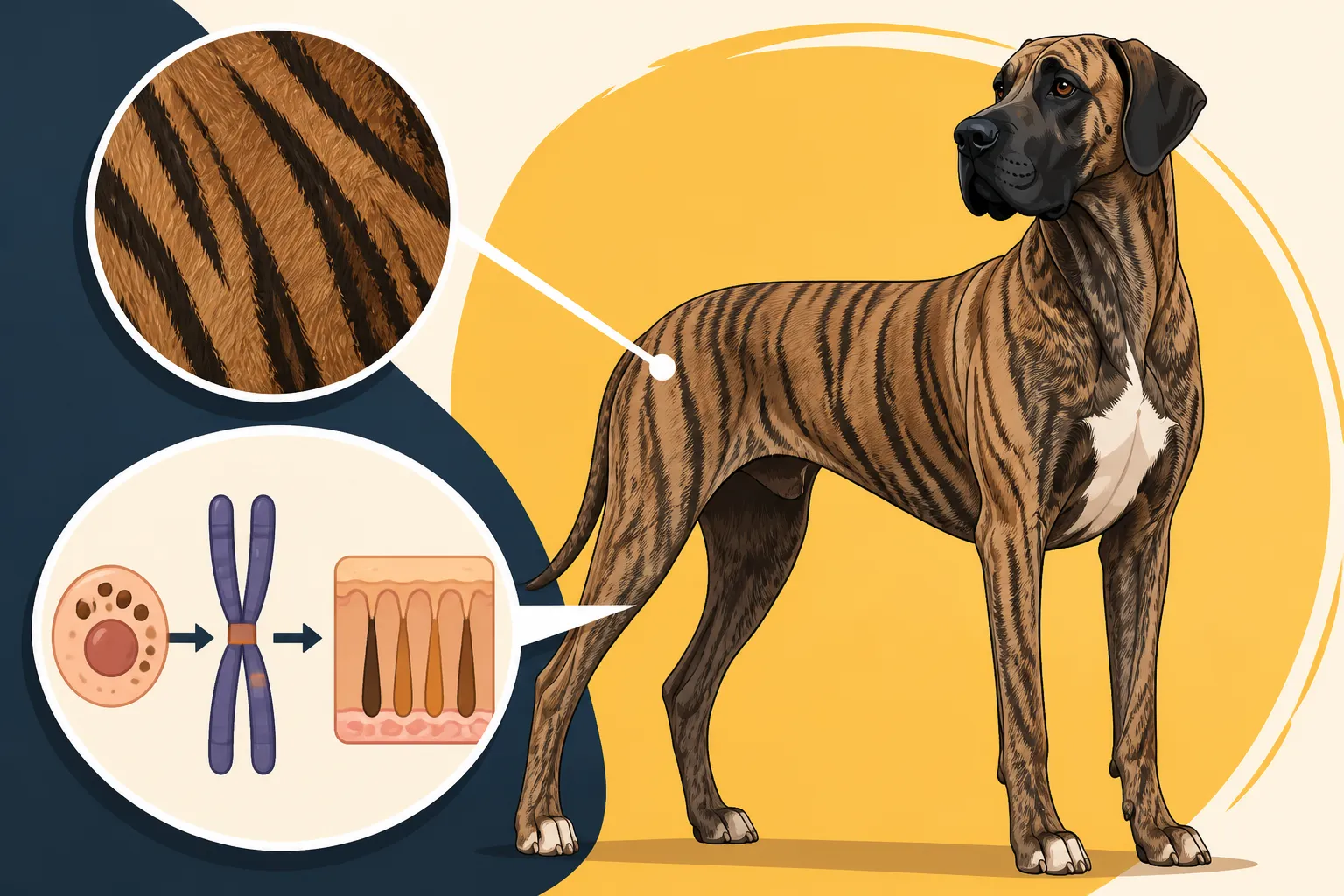
How Brindle Stripes Form on a Great Dane
If you've ever found yourself marveling at the striking patterns on a Brindle Great Dane, you're not alone. That intricate tapestry of stripes is a true wonder, and it’s completely natural to be curious about how such a distinctive coat develops. It’s not just a random splash of color; it’s a fascinating dance of genetics, with specific genes dictating every stripe and shade. This guide will demystify the science behind those beautiful brindle coats, helping you understand the genetic mechanics that create this unique Great Dane pattern.
The Genetic Blueprint of Great Dane Coat Colors
Understanding how a Brindle Great Dane gets its stripes really begins with a basic grasp of canine coat color genetics. It's a complex world of dominant and recessive genes, each playing a crucial role in determining what a puppy's coat will look like. Think of it like a set of instructions, passed down from parent to pup, with different sections controlling different aspects of color and pattern.
Understanding Basic Color Genes
Every dog carries two copies of each gene, one inherited from each parent. These gene copies are called alleles, and their combination dictates specific traits, like coat color. For Great Danes, several gene locations, or 'loci' as geneticists call them, are particularly important. We're talking about more than just "black" or "white"; it’s about the underlying code that produces those pigments. Without a solid understanding of these foundational genes, the brindle pattern would seem like pure magic, but it’s actually a very logical genetic outcome.
The main pigment responsible for black and brown shades is called eumelanin, while phaeomelanin produces the red and yellow tones. The presence, absence, and modification of these two pigments, driven by various gene loci, create the stunning array of Great Dane colors we all admire. For a long time, breeders and owners relied on visual cues, but genetic testing now offers a precise look at the hidden instructions within each dog. You can often find breeders referencing genetic test results for their breeding stock, which is a fantastic way to understand the potential colors in a litter. The Health Testing a Great Dane Breeder Owes You often includes these genetic panels.
The K Locus and its Influence
When it comes to brindle, one particular gene locus is the star of the show: the K locus. This locus has a profound impact on how a dog's base color is expressed. There are three primary alleles at the K locus, each with a different effect on the coat:
- K^B (Dominant Black): This is the most dominant allele at the K locus. If a Great Dane inherits even one copy of K^B, it will likely express as a solid black coat, regardless of other color genes, unless modified by other genes (like merle or dilution). It essentially overrides other patterns.
- k^br (Brindle): This is the allele we're most interested in for brindle Great Danes. It's recessive to K^B, meaning a dog needs two copies of k^br (or one k^br and one k^y) to express brindle, assuming no dominant black is present.
- k^y (Yellow/Fawn): This is the most recessive allele at the K locus. A dog with two k^y alleles will express whatever color is dictated by its A locus (agouti series), which is often fawn in Great Danes.
The way these alleles combine determines whether a Great Dane will be solid black, brindle, or fawn. For a dog to be brindle, it must not have the dominant K^B allele. Instead, it needs at least one k^br allele and a suitable base color from another locus to show those stripes. This interaction is key to understanding the majestic appearance of a brindle Dane.
Unpacking the Brindle Allele (k^br)
The k^br allele is truly fascinating because it doesn't create a color out of thin air; rather, it acts as a modifier on an existing base color. Think of it less as a painter choosing a new color, and more as a stencil applied over a pre-existing canvas. This is why you see those distinct stripes laid over a lighter background.
How Brindle Stripes Manifest
A brindle Great Dane typically showcases black stripes against a lighter base color, most commonly fawn or a tawny, yellowish-brown. The stripes can vary wildly in their intensity, thickness, and how much of the body they cover. Some brindles have very fine, sparse stripes, almost like a faint tiger pattern, while others have what's often called a "reverse brindle" – so many black stripes that the base fawn color only shows through as thin lines. It's really quite a spectrum!
The k^br allele genetically instructs the phaeomelanin (red/yellow pigment) to be replaced by eumelanin (black pigment) in specific striped areas. So, if a dog has the genetic instructions to be fawn (phaeomelanin), the brindle gene steps in and says, "Hold on, in these particular spots, we're going with black instead!" This creates that characteristic striped effect. It's not about two separate colors existing side-by-side as independent genes; it's one gene modifying the expression of another. It’s similar to how some dogs have a distinct black mask, where black eumelanin is concentrated on the muzzle, even if the rest of the coat is fawn. This genetic interplay is what makes a brindle Great Dane so visually striking and utterly unique among the many The Seven Great Dane Colors.
The Role of the A Locus
While the K locus dictates the pattern of brindle, it's another locus, the A locus (agouti series), that provides the canvas for those stripes. For a brindle pattern to actually show on a Great Dane, the dog typically needs to have certain alleles at the A locus. Specifically, the A^y (fawn or sable) allele is usually present.
Here's how it works:
- If a Great Dane has two k^y alleles at the K locus (meaning no brindle or dominant black), its coat color will be determined by the A locus. If it has A^y A^y or A^y a^t (sable/tan points), it will be fawn or sable.
- The k^br allele, when present, works its magic by modifying this fawn (or sable) base color. It "paints" the black stripes over the phaeomelanin-producing areas. Without the A^y allele providing that fawn background, the brindle stripes wouldn't have anything light to stand out against. For instance, if a dog had a recessive black allele (a) at the A locus, and was also homozygous for brindle (k^br k^br), it would just look like a black dog, because there’s no fawn pigment to be modified.
This is why, when you look at a Brindle Great Dane, you consistently see those black stripes on a fawn backdrop. The genetic combination is usually k^br k^br (or k^br k^y) at the K locus, coupled with at least one A^y allele at the A locus. This ensures the foundational fawn color is there for the brindle pattern to lay upon. The Fawn Great Dane and Its Black Mask is a testament to how crucial these base colors and their modifiers are in Great Dane aesthetics.
Why Some Danes Are Brindle and Others Aren't
The appearance of a brindle coat isn't a roll of the dice; it's a predictable outcome of genetic inheritance. When two Great Danes breed, they each pass on one allele from each gene locus to their offspring. This is where understanding dominant and recessive traits becomes incredibly useful for predicting a litter's potential coat colors.
Parental Contributions and Punnett Squares
To understand why some pups are brindle while their littermates might be fawn or black, we can look at the alleles carried by the parents. Let’s focus on the K locus (K^B for dominant black, k^br for brindle, and k^y for fawn).
Here's a simplified example:
- Case 1: Both parents carry the k^br allele.
- If Parent 1 is (k^br k^y) and Parent 2 is (k^br k^y), you could have puppies that are (k^br k^br), (k^br k^y), or (k^y k^y). All of the (k^br k^br) and (k^br k^y) puppies would be brindle, provided they also have the A^y allele at the A locus. The (k^y k^y) puppies would be fawn.
- Case 2: One parent is dominant black (K^B).
- If Parent 1 is (K^B K^B) and Parent 2 is (k^br k^br), all the puppies will inherit at least one K^B allele, making them (K^B k^br). These puppies will all be dominant black, even though they carry the brindle gene, because K^B is dominant.
This is why reputable Great Dane breeders keep careful records of their dogs' pedigrees and often perform genetic testing. They understand the intricacies of these pairings to produce desired coat colors and, more importantly, to ensure healthy offspring. A quick search on Chewy for genetic testing kits might even show you options for pet owners curious about their dog's genetic makeup, though a vet consultation is always the best route for comprehensive understanding.
It's also why sometimes you'll see a litter where a fawn parent and a black parent somehow produce brindle puppies. It means both parents secretly carried the k^br or k^y alleles, even if one of them expressed dominant black. It’s all about what genes are silently carried.
Variations in Brindle Patterns
Even within a litter of brindle Great Danes, you’ll notice that no two brindle patterns are exactly alike. This isn't just about random chance; it's a testament to the subtle influence of other modifying genes and the inherent variability in genetic expression. Some brindles might have thick, bold black stripes that dominate the fawn base, making them appear quite dark, often referred to as "reverse brindle." Others might have very delicate, fine stripes that are barely visible unless you're up close, giving them a much lighter overall appearance.
Factors that can contribute to this variation, although less understood than the primary K and A loci, might include:
- Polygenic modifiers: It's believed that a combination of multiple genes (polygenes) can influence the expression of the brindle pattern, affecting stripe width, density, and saturation. These aren't primary color genes, but rather subtle enhancers or suppressors.
- Stripe direction and flow: The way the stripes flow over the body can also differ, creating unique visual effects. Some might have a more vertical stripe pattern, while others show more swirling or broken lines.
- Base coat richness: The underlying fawn color itself can vary in richness from a pale cream to a deep, reddish-gold. This base color variation, governed by other genes, will naturally impact how the black stripes appear against it. A darker fawn base might make the stripes blend more, while a lighter base will make them pop more distinctly.
Ultimately, while the k^br allele is responsible for the presence of brindle stripes, the exact artistry of the pattern is a unique expression for each individual Great Dane, making every brindle truly one-of-a-kind. When considering Great Danes Against the Other Giant Breeds, you'll find that while many breeds have brindle, the Great Dane's sheer size and elegant structure make the pattern particularly magnificent.
Brindle in the Great Dane Standard and Beyond
For those interested in the official recognition of the brindle pattern, breed standards are the go-to guide. These standards describe the ideal appearance of a Great Dane, including acceptable coat colors and patterns. The brindle pattern is not only accepted but highly admired within the Great Dane community.
The AKC Standard for Brindle Great Danes
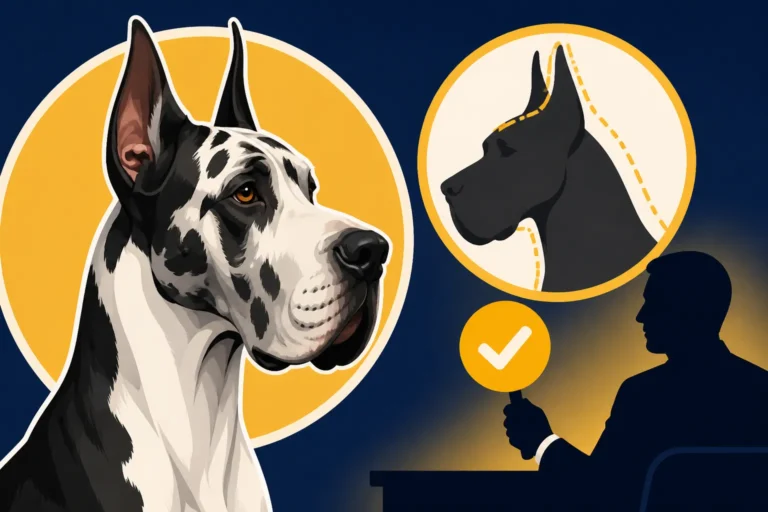
The American Kennel Club (AKC) breed standard for Great Danes specifically recognizes brindle as one of the acceptable coat colors. The standard describes it as: "A fawn base color striped with black in a chevron pattern." It further specifies that "the more evenly and clearly defined the stripes, the better," and that the stripes should "appear as if painted on the fawn ground." This emphasis on definition and evenness highlights the ideal aesthetic for a show-quality brindle.
Furthermore, a black mask is typically present and desired on a brindle Great Dane, just as it is on fawn Danes. This mask, extending around the eyes and muzzle, adds to the striking contrast and noble expression of the breed. While the brindle pattern itself is a genetic marvel, the combination with the classic Great Dane build and head type creates a truly regal animal. For breeders aiming for conformation, understanding these nuanced details is crucial. When looking for a puppy, always ask a breeder about The Great Dane the Show Ring Is Looking For and how their lines align with these standards.
Here's a quick reference table for the K-Locus alleles:
| Allele | Description | Dominance Order (Most to Least) | Typical Visual Effect (with A^y) |
|---|---|---|---|
| K^B | Dominant Black | 1 (Most Dominant) | Solid Black |
| k^br | Brindle | 2 | Black Stripes on Fawn |
| k^y | Non-Black/Yellow/Fawn Basis | 3 (Most Recessive) | Fawn (no stripes) |
This table helps illustrate the hierarchy of these alleles and why certain combinations lead to specific coat presentations. It’s a helpful tool for anyone trying to decipher the coat colors of a Great Dane litter.
Health and Temperament: Is Brindle Different?
One of the most reassuring aspects of the brindle coat color in Great Danes is that, unlike some other patterns (such as double merle, which can lead to significant health issues like deafness and blindness), the brindle gene itself is not associated with any specific health problems or temperament traits. A brindle Great Dane is, genetically speaking, just as healthy and possesses the same wonderful temperament as its fawn, black, or blue counterparts. Whether Great Dane Color Affects Health is a valid concern for many owners, and thankfully, brindle doesn't pose any unique risks.
The Great Dane's renowned "gentle giant" temperament is universal across all standard colors. Any variations in personality come down to individual genetics for temperament, socialization, training, and individual life experiences, not the color of their fur. So, whether your Dane is a vibrant brindle, a classic fawn, or a sleek black, you can expect the same loyal, affectionate, and sometimes clumsy companion.
However, choosing a puppy from a reputable breeder remains paramount, regardless of color. A good breeder will prioritize health screenings for common Great Dane ailments like cardiac issues (Screening a Great Dane's Heart Each Year), hip and elbow dysplasia (Great Dane Hip and Elbow Screening), and bloat risk. They will also focus on breeding for sound temperament, ensuring that each puppy has the best possible start in life. The coat color is just one beautiful aspect of the breed, not a determinant of health or character. Always choose a breeder who emphasizes the overall well-being and genetic health of their lines over specific color trends. When looking for supplies for your brindle beauty, remember Chewy offers a wide range of products suitable for any Great Dane, ensuring you can find everything from nutritious food to cozy beds that support their big bodies and help prevent issues like Elbow Hygromas on a Great Dane.
The brindle Great Dane is a stunning example of genetic artistry, a living tapestry of black stripes against a golden background. The k^br allele, working in concert with the A locus, creates a pattern that is both visually captivating and genetically sound. Understanding how these stripes form deepens our appreciation for the complexity of canine genetics and the diverse beauty of the Great Dane breed.
Disclaimer
This article is for general informational purposes only and does not constitute professional advice. Laws, prices and regulations vary by location and change over time. Consult a qualified professional for guidance on your specific situation.