Harlequin and Merle Great Dane Genetics
The striking appearance of Harlequin and Merle Great Danes often captivates admirers, but beneath their unique patterns lies a complex genetic tapestry that prospective owners and breeders must understand. Many folks are drawn to these colors without fully grasping the potential health implications or the intricacies of how these patterns come to be. This guide will unravel the genetics behind Harlequin and Merle Great Danes, explaining how these beautiful coats are created, the risks involved, and why responsible breeding is absolutely paramount.
Understanding the Foundation of Great Dane Coat Colors
Before we dive into the fascinating world of Harlequin and Merle, it's essential to grasp the basic genetics that lay the groundwork for any Great Dane's coat. Think of it like a painter starting with a canvas – you need a base color before you can add any intricate designs or patterns. The genetic code of a Great Dane is a sophisticated instruction manual, with different sections, or "loci," determining various traits, including their coat.
The Basic Genetic Loci at Play
In the world of dog genetics, specific locations on a chromosome, known as loci, hold genes that dictate coat color. Each gene can have different variations, called alleles. These alleles are inherited from both parents, and whether they are dominant or recessive determines how they are expressed visually. For instance, a dominant allele will show its trait even if only one copy is present, while a recessive allele needs two copies (one from each parent) to be expressed.
For Great Danes, some of the foundational genes include those that determine whether a dog is black-based or red-based (like fawn or brindle), and genes that modify those base colors, such as diluting black to blue. These interactions are fundamental. For example, the B locus determines whether a dog can produce black pigment. A dog with at least one dominant 'B' allele will have black pigment in its coat and nose, while a 'bb' genotype results in brown or liver pigment, which is not a standard color for Great Danes but can exist. Similarly, the D locus affects the intensity of pigment; a 'dd' genotype will dilute black to blue and red to cream, giving us stunning Blue Great Danes.
Why Solid Colors Are Simpler to Predict
When you look at a Fawn, Black, Brindle, or Blue Great Dane, their coat color genetics are generally more straightforward than those of a Harlequin or Merle. These colors usually involve fewer interacting genes and are often expressed as a direct result of homozygous or heterozygous combinations of dominant and recessive alleles at a few key loci. For instance, a Fawn Great Dane gets its rich golden-tan color from the A and E loci, combined with a dominant 'B' for black pigment in its mask and points. A Brindle Dane has the same fawn base, but with a specific allele at the K locus that adds those distinctive black stripes.
Black Great Danes are simply expressing dominant black genes without other pattern modifiers. Blue Great Danes are genetically black dogs where a recessive dilution gene (dd) causes the black pigment to appear steel gray. While still requiring a foundational understanding of dominant and recessive inheritance, these patterns don't involve the complex interplay of pigment dilution and spotting genes in the same way that Harlequin and Merle do. They provide a clear "canvas" onto which the more intricate merle and harlequin patterns might later be applied. Understanding these basics helps us appreciate the complexity when the merle and harlequin genes enter the picture, as they don't create a color from scratch, but rather modify an existing one.
Deciphering the Merle Gene (M Locus)
The merle gene is arguably one of the most visually striking, and genetically complex, genes in the Great Dane breed. It's responsible for the patchwork, dappled effect that many find so appealing. However, its beauty comes with significant responsibility for breeders and owners.
What is the Merle Allele?
The merle gene, located at the M locus, is a dominant modifier gene that causes random dilution of the base coat color. Imagine taking a solid black dog and selectively removing patches of pigment, leaving behind diluted gray, while other patches remain dark. That's essentially what the merle gene does. A Great Dane inherits two alleles for the M locus, one from each parent.
There are primarily two alleles we consider here: 'm' (non-merle) and 'M' (merle).
- mm: A dog with two 'm' alleles is non-merle. It will have a solid coat color based on its other genes (e.g., black, fawn, blue).
- Mm: A dog with one 'M' allele and one 'm' allele is a heterozygous merle. This is the classic merle pattern you typically recognize – patches of full pigment and patches of diluted pigment, usually with blue or odd-colored eyes. A "Blue Merle" Great Dane, for instance, would be a black-based dog with the Mm genotype, resulting in diluted gray patches on a black base.
- MM: A dog with two 'M' alleles is a homozygous merle, often referred to as a "double merle." This is where significant health concerns arise, as the double dose of the merle gene leads to extreme dilution and often profound sensory defects. This is why Why Two Merle Great Danes Should Not Be Bred is a critical piece of information for responsible breeders and future owners.
The Spectrum of Merle Expression
Merle isn't just one look; its expression can vary widely depending on the base coat color and the specific modifier genes present. For example, a dog with a black base and the Mm genotype will appear as a "Blue Merle," with striking gray and black patches. If the base coat is fawn, the merle gene will create a "Fawn Merle" or "Red Merle," diluting the fawn to a lighter tan or cream in patches. The merle pattern itself can range from very bold and distinct patches to more subtle, almost blended areas.
Sometimes, a dog can carry the merle gene but show very little or no visual evidence of it. This is known as "cryptic merle" or "phantom merle." These dogs have an 'M' allele but it's often a shorter version, m(c), which doesn't express strongly. A cryptic merle might look like a solid-colored dog, but genetically, they carry merle. This poses a challenge for breeders because if a cryptic merle is bred to a visible merle, they can still produce double merles with all the associated health problems. This is why genetic testing for the merle gene is so vital, especially when planning a breeding.
Health Concerns Associated with Merle
While the heterozygous merle (Mm) typically has no inherent health problems directly linked to the gene itself beyond potential blue eyes, the homozygous merle (MM), or "double merle," carries significant health risks. When a Great Dane inherits two copies of the merle gene, the extreme dilution effect extends beyond coat color to the development of sensory organs.
The most common and severe issues in double merles are related to sight and hearing. Many double merles are born deaf, blind, or both. Their eyes can be severely underdeveloped (microphthalmia), or they might have colobomas (missing tissue in the eye structures), leading to significant vision impairment or complete blindness. Missing Eyes and Small Eyes in White Great Danes specifically covers some of these profound issues. These issues stem from the fact that pigment cells play a crucial role in the development of the inner ear and the structures of the eye. Without adequate pigment, these delicate systems can't form correctly.
Beyond these major sensory deficits, double merles can also have compromised immune systems, heart defects, or reproductive issues, though these are less common than the eye and ear problems. Owning a double merle requires immense dedication, patience, and often specialized care. Owners need to learn alternative communication methods, such as Hand Signals for a Great Dane That Cannot Hear, and make significant environmental adjustments to ensure the dog's safety and quality of life. This is why responsible breeders are so adamant about avoiding merle-to-merle breedings; the potential for producing severely affected puppies is simply too high.
The Intricate Harlequin Pattern (H Locus)
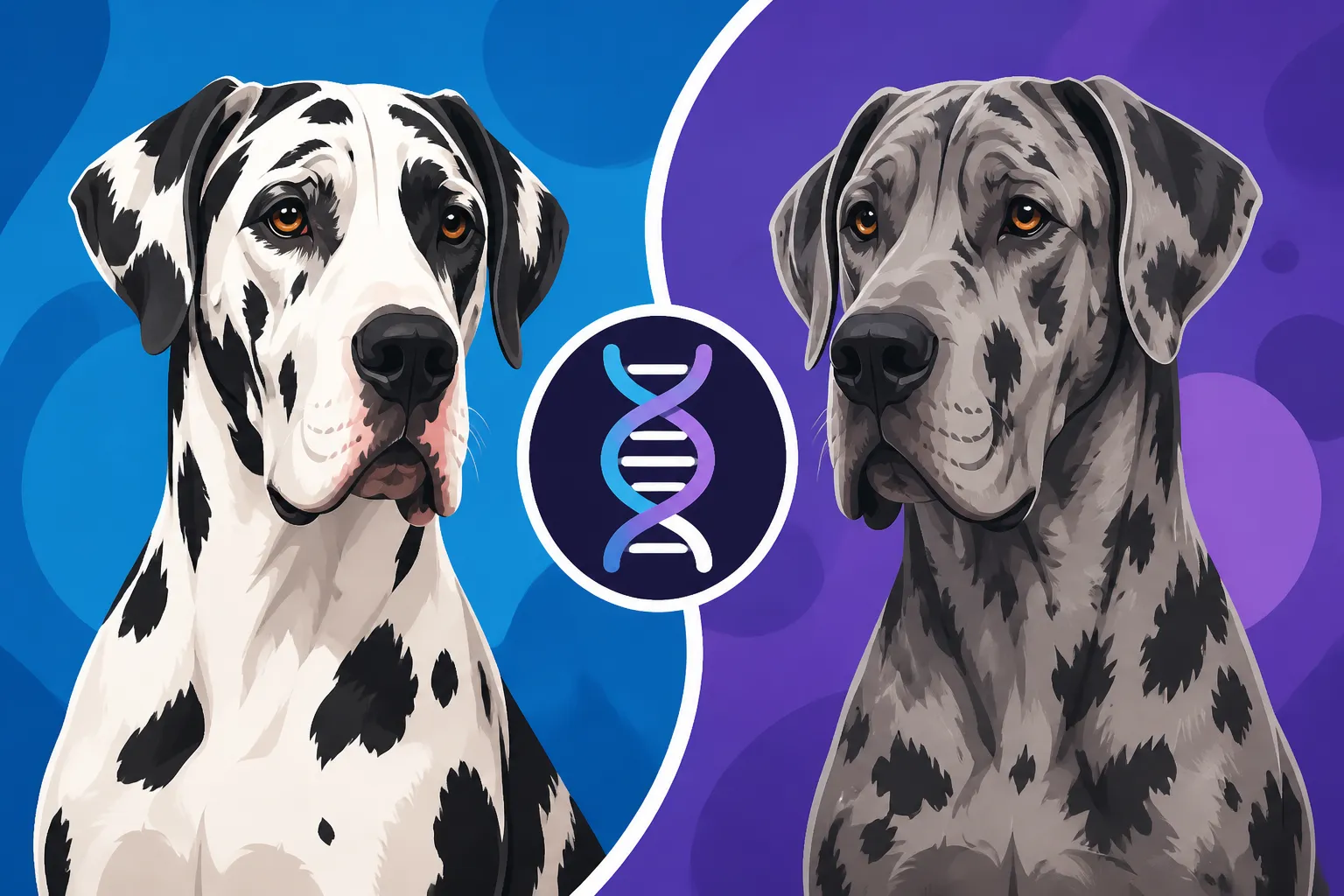
The Harlequin Great Dane is arguably one of the most iconic and desired color patterns in the breed. Its striking patches of black on a pure white background are instantly recognizable. However, achieving this pattern involves a complex genetic dance between the merle gene and a separate modifier gene known as Harlequin.
The Unique Role of the Harlequin Gene (H)
The Harlequin gene, denoted as 'H', doesn't create a pattern on its own. Instead, it acts as a modifier gene that can only express itself in the presence of at least one merle gene (Mm). Think of the merle gene as turning on a switch that allows the Harlequin gene to then paint its unique pattern. Without the merle gene, the Harlequin gene remains silent.
The 'H' allele is dominant, meaning only one copy (Hh) is needed to produce the Harlequin pattern if the merle gene (Mm) is also present. The 'h' allele is recessive, and a dog with 'hh' will express its merle pattern without the harlequin modification. The Harlequin gene modifies the merle pattern by changing the diluted gray areas into pure white, while leaving the black patches intact and ideally, sharply defined with a torn or jagged edge. This results in the classic white base with scattered black patches that define a Harlequin.
Crucially, the homozygous form (HH) of the Harlequin gene is considered embryonically lethal. This means that if a puppy inherits two copies of the dominant 'H' allele, it typically does not survive past early embryonic development and is reabsorbed by the mother's body. This genetic reality means that you will never see a live-born HH Harlequin dog, and it's another reason why Harlequin breeding requires such careful planning.
How Merle and Harlequin Interact
The interplay between the merle and harlequin genes is fascinating and can be a bit tricky to grasp without understanding the individual roles. Let's break down the essential genotypes:
- mmhh: This dog is solid colored (non-merle, non-harlequin). It could be black, fawn, brindle, or blue, depending on other genes.
- Mmhh: This dog is a merle (e.g., Blue Merle if black-based). The merle gene is present, but the recessive 'hh' means the harlequin modifier cannot act, so the dog displays the typical merle pattern with diluted gray patches.
- MmHh: This is the genotype for a true Harlequin Great Dane. The merle gene (Mm) provides the necessary canvas, and the dominant Harlequin gene (Hh) then transforms the diluted merle patches into crisp white, leaving the undiluted black patches. This is the desired combination for creating the beautiful Harlequin coat.
- MMHh or MMhh: These combinations would result in a double merle, with all the associated health risks. The Harlequin gene (Hh) might attempt to act on the double merle, but the fundamental issues of extreme depigmentation and associated health problems would still be present, often resulting in "white" Danes with profound health issues.
- mmHh: This dog would be solid colored. Remember, the Harlequin gene cannot express without the merle gene. So, even with Hh, if there's no M, there's no Harlequin pattern.
The critical takeaway is that a Harlequin Great Dane is always genetically a merle, but a merle Great Dane is not always a Harlequin. The Harlequin gene is the "switch" that turns the gray merle areas white. This intricate relationship means that in any litter from a Harlequin parent, you will almost certainly see merle puppies, solid puppies, and potentially "white" puppies depending on the breeding pair. What Comes Out of a Harlequin Great Dane Litter can be quite a mix!
Breeding Harlequins and the Challenges Involved
Responsible breeding of Harlequin Great Danes is one of the most challenging aspects of Great Dane genetics. Because the Harlequin gene (H) is lethal in its homozygous form (HH), and it requires the merle gene (M) for expression, breeders must be extremely careful to avoid producing puppies with severe health issues or non-viable litters.
The standard and most responsible breeding practice for Harlequins is to breed a Harlequin (MmHh) to a solid-colored dog that is not merle and does not carry the harlequin modifier (mmhh), typically a Mantle or a Black Great Dane. This pairing minimizes the risk of producing double merles (MM) or the lethal HH combination.
Here’s why this strategy is preferred:
- Harlequin (MmHh) x Mantle/Black (mmhh): This pairing ensures that no MM (double merle) puppies will be produced, as the solid parent contributes only 'm' alleles. It also avoids the lethal HH combination, as the solid parent contributes only 'h' alleles. The resulting litter will typically contain Harlequins (MmHh), Merles (Mmhh), and solid blacks or mantles (mmhh). This allows for the continuation of the Harlequin line while maintaining genetic health.
- Harlequin (MmHh) x Merle (Mmhh): This pairing is extremely risky. While it might produce Harlequins, it also has a 25% chance of producing double merle (MM) puppies, which are prone to severe health issues like deafness and blindness. This is why it is strongly discouraged by ethical breeders.
- Harlequin (MmHh) x Harlequin (MmHh): This breeding is considered highly irresponsible. It carries a 25% chance of producing double merle (MM) puppies, a 25% chance of producing the lethal HH genotype (meaning those embryos will be lost), and a chance of producing "white" puppies that, while not genetically HH, often exhibit the same profound health problems as double merles due to extensive depigmentation.
Ethical breeders prioritize the health and well-being of the puppies above all else. They understand that while a stunning What a Correct Harlequin Great Dane Looks Like is beautiful, it must come from a responsible breeding program that utilizes genetic testing and adheres to established guidelines to prevent suffering. They also understand that the offspring of Harlequin breeding can include merles, blacks, and mantles, and these are all valuable and healthy dogs.
The Genetics Behind the Other Allowed Colors and Their Interaction with Merle
While Harlequin and Merle are often the focus of genetic discussions due to their complexity, it's important to remember that they are built upon the foundation of the Great Dane's other standard colors. Understanding these base colors and their genetic underpinnings helps paint a complete picture of Great Dane coat genetics.
Solid Colors: Black, Fawn, Brindle, Blue
These are the foundational coat colors that serve as the canvas for any merle or harlequin pattern. They are determined by various genetic loci, including:
- A Locus (Agouti Series): This locus determines how black pigment is distributed. For Fawns and Brindles, the 'ay' allele (sable/fawn) is responsible for the red/tan base. For black dogs, the 'a' allele (recessive black) is present, allowing for solid black.
- E Locus (Extension Series): This locus controls whether black pigment is allowed to extend throughout the coat. The 'E' allele allows full expression, while 'e' results in recessive red (which is not a standard Great Dane color, but illustrates the gene's function). The 'Em' allele is responsible for the black mask seen on Fawn and Brindle Danes.
- B Locus (Brown/Black): As mentioned earlier, 'B' leads to black pigment, 'b' leads to brown. Since brown/liver is not a standard color, all standard Great Danes have at least one dominant 'B' allele.
- D Locus (Dilution): The 'D' allele allows full pigment intensity, while 'd' causes dilution. A 'dd' genotype turns black pigment into blue (a steel gray) and fawn into a lighter cream or Isabella. This is how we get the beautiful Blue Great Danes.
A Great Dane's color is the sum of these genetic parts. For example, a Fawn Great Dane is typically 'ay/ay', 'Em/', 'B/', 'D/_', meaning it expresses fawn with a black mask, has black pigment potential, and no dilution. These solid colors are genetically stable and don't carry the same inherent health risks as the merle and harlequin modifiers, assuming responsible breeding practices are followed.
Mantle Great Danes and Their Importance in Breeding
Mantle Great Danes, with their distinct black and white pattern – typically a solid black blanket, white chest, white legs, white collar, and white blaze – are often mistaken for Harlequins by those unfamiliar with the subtle genetic differences. However, they are genetically quite distinct and play a crucial role in the responsible breeding of Harlequins.
Genetically, a Mantle Great Dane is a black dog with specific white spotting genes (at the S locus). They are 'mmhh' (non-merle, non-harlequin) when it comes to the M and H loci. This is their superpower in Harlequin breeding. Because Mantle Danes do not carry the merle or harlequin genes, breeding a Harlequin to a Mantle guarantees that no double merles (MM) or lethal homozygous Harlequins (HH) will be produced. The Mantle provides a safe genetic counterpart, contributing only the 'm' and 'h' alleles, which helps ensure healthier litters when combined with a Harlequin.
This careful selection of breeding partners showcases the deep understanding of genetics required for ethical Great Dane breeding. A breeder might refer to them as "Harl-bred" blacks or mantles, indicating they come from a Harlequin line and are suitable for future Harlequin breeding programs.
The "Faulty" Colors and Their Genetic Basis
In Great Dane breeding, "faulty" colors aren't necessarily about health but about adherence to the breed standard. The American Kennel Club (AKC) and other kennel clubs define specific colors and patterns as acceptable for the breed. Any deviation, even if the dog is perfectly healthy, would be considered a "fault" in the show ring and generally discouraged in responsible breeding programs.
Examples of "faulty" or non-standard colors that can arise, especially from irresponsible breeding involving merle, include:
- Fawn Merle or Blue Merle: While genetically possible, these are not standard colors in the Great Dane breed. A Fawn Merle would be a fawn dog with merle patches, and a Blue Merle would be a black-based dog with merle patches (the merle gene dilutes the black to gray in patches). Breeders who produce these colors, particularly from merle-to-merle breedings, are often prioritizing novelty or profit over breed standards and health. Colors the Great Dane Standard Does Not Allow are carefully defined for a reason.
- Merle Harlequin: This describes a dog that has some Harlequin patterning but also retains significant areas of diluted gray merle, rather than the pure white patches desired in a classic Harlequin. It indicates an imperfect expression of the Harlequin modifier.
- White Great Danes (from Harlequin/Merle breeding): While not technically a 'faulty' color in the sense of being an unexpected base color, excessively white Danes resulting from double merle or certain Harlequin breedings are often prone to severe health issues. These dogs are largely white due to extreme depigmentation, and like double merles, can suffer from deafness, blindness, and other developmental problems. While some white markings are part of the standard for Mantle and Harlequin, a predominantly or entirely white coat in a Great Dane is a red flag for genetic issues.
The reason responsible breeders strive for standard colors and patterns isn't just aesthetic. It's often linked to maintaining genetic health and avoiding the pitfalls of unregulated breeding practices. While some of these "faulty" colors might be perfectly healthy themselves, their presence in a litter can signal risky breeding choices or a lack of understanding of complex Great Dane genetics.
Identifying and Testing for Merle and Harlequin Genes
For anyone involved with Great Danes – whether as a loving pet owner, a prospective buyer, or an aspiring breeder – understanding how to identify and test for the merle and harlequin genes is crucial. Visual identification alone can be deceptive, and genetic testing provides the definitive answers needed for responsible decision-making.
Visual Identification vs. Genetic Testing
Visually identifying a merle or harlequin Great Dane seems straightforward. A merle dog will have patchy, diluted areas of color on its base coat, often with blue eyes or heterochromia (two different colored eyes). A harlequin will have distinct black patches on a predominantly white body. However, looks can be deceiving, and relying solely on visual cues can lead to serious errors in breeding and care.
Consider the "cryptic merle." This is a dog that carries the merle gene (Mm) but displays little to no visible merle patterning. Its coat might appear solid, or it might have very subtle, almost unnoticeable patches of dilution. A breeder who doesn't genetically test might mistakenly believe this dog is a non-merle (mm) and breed it to a visible merle, unintentionally creating double merle (MM) puppies with severe health issues. Similarly, a very light merle could be mistaken for a white Great Dane, and vice versa.
This is where genetic testing becomes indispensable. A simple DNA test, usually done with a cheek swab collected by a veterinarian or sent directly to a specialized lab, can accurately determine a dog's genotype at the M (merle) and H (harlequin) loci. This test will reveal if a dog is mm (non-merle), Mm (merle), or if it carries the harlequin modifier (Hh). This objective information removes all guesswork and is critical for planning safe and ethical breeding pairs.
The Role of Responsible Breeders
Responsible Great Dane breeders operate with a deep commitment to the health and well-being of their dogs and the future of the breed. For them, genetic testing for merle and harlequin is not an option, but a mandatory part of their breeding program. The Health Testing a Great Dane Breeder Owes You extends far beyond hips and elbows; it includes comprehensive genetic panel testing.
Ethical breeders will:
- Routinely test their breeding stock: Before any breeding takes place, both male and female dogs will be tested for the merle and harlequin genes, along with other relevant genetic health screenings. This ensures they know the exact genetic makeup of their potential parents.
- Be transparent with results: They will readily share the genetic test results with prospective puppy buyers. When looking for a puppy, ask to see the parents' health certifications and genetic panel results, including the merle and harlequin loci. Reading a Great Dane Puppy's Health Papers should always be a priority.
- Plan breedings strategically: With full knowledge of their dogs' genotypes, responsible breeders meticulously plan pairings to avoid producing double merles or non-viable embryos from HH combinations. This often means breeding Harlequins to solid blacks or mantles, as discussed earlier.
- Educate prospective owners: They take the time to explain the genetics, potential health risks, and the commitment involved, especially if a puppy carries the merle gene or is a Harlequin. They are not simply selling a color; they are placing a living being with complex genetic traits.
By prioritizing genetic screening, responsible breeders act as guardians of the breed, working to minimize the incidence of preventable genetic diseases and ensure that future generations of Great Danes are as healthy as they are beautiful. When selecting a Great Dane puppy, particularly a Harlequin or Merle, the breeder's commitment to and transparency about genetic testing should be one of your top considerations.
Living with Harlequin and Merle Great Danes
Bringing any Great Dane into your home is a huge commitment, but for Harlequin and Merle Danes, especially those from risky breedings or with unique expressions, the commitment can be even greater. It’s about being prepared for potential special needs and ensuring you can provide a loving, supportive environment.
Special Care for Double Merles and White Danes
While responsible breeding aims to prevent double merles, they do exist, often from accidental matings or irresponsible breeders. Similarly, some "white" Great Danes, which can result from merle-to-merle or certain Harlequin breedings, exhibit many of the same challenges. These dogs, though often overlooked or given up, can live full, happy lives with dedicated owners who understand their needs.
- Deafness: Many double merles and white Danes are born completely deaf. This requires a shift in how you communicate. Voice commands won't work, so you'll need to learn and consistently use hand signals. There are many resources available for training deaf dogs, and they can be just as intelligent and trainable as hearing dogs. Hand Signals for a Great Dane That Cannot Hear is a valuable tool for these amazing dogs. Their world is silent, so visual cues, vibrations, and scent become paramount. You might need to adjust your home environment, for instance, by using vibration collars for recall in a fenced yard, or always approaching them from the front to avoid startling them.
- Vision Impairments: From microphthalmia (abnormally small eyes) to partial or complete blindness, vision issues are common. Dogs adapt remarkably well to vision loss, especially if it's congenital. Keep furniture in consistent places, use scent markers, and teach verbal cues for obstacles. Their other senses become heightened. While the condition can be heartbreaking, these dogs often navigate their world with surprising grace, relying heavily on their memory and sense of smell. Regular vet check-ups are essential to monitor eye health and prevent secondary issues.
- Sun Protection: Dogs with extensive white pigmentation, especially around their noses and ears, are more susceptible to sunburn and skin cancer. Regular application of dog-safe sunscreen and limiting sun exposure during peak hours are important preventative measures.
- Behavioral Considerations: Some double merles or extensively white Danes, due to their sensory deficits, can be more prone to anxiety or fear-based behaviors if not properly socialized and managed. Patience, positive reinforcement, and understanding are key to building their confidence.
These dogs are not "damaged goods"; they are simply unique individuals who require a little extra understanding and accommodation. Their capacity for love and joy is just as boundless as any other Great Dane.
Understanding the Commitment of Owning These Colors
Taking on a Great Dane, particularly one with potential genetic health challenges, is a significant long-term commitment. It's not just about providing food and shelter; it's about providing specialized care, training, and financial resources.
- Time and Effort: Training a deaf or visually impaired dog requires more time and consistency. Adapting your home and routine to their needs will be a daily endeavor. This might mean enrolling in specialized training classes or working closely with a behaviorist experienced with sensory-impaired dogs.
- Financial Preparedness: Veterinary care for a double merle or a white Dane with health issues can be substantial. Regular check-ups, potential specialist consultations (ophthalmologists, audiologists), and any necessary medications can add up. This is where pet insurance can be a literal lifesaver. Whether Pet Insurance Is Essential for a Great Dane is a question that many giant breed owners ponder, and for those with special needs, it becomes even more critical. You might find yourself needing to order specialized equipment, such as a raised dog bed from a trusted retailer like Chewy that stocks a wide variety of large-breed accessories to ensure comfort.
- Emotional Resilience: It can be emotionally taxing to care for a dog with significant challenges. There will be good days and tough days. Building a support network, whether through online communities or local dog groups, can be incredibly helpful.
- Finding the Right Supplies: Everything for a Great Dane is already supersized, but for special needs dogs, it's even more crucial. You'll need extra-large and comfortable bedding to support their joints, which you can usually find through reputable online pet supply stores. Toys, feeders, and even training aids might need to be specifically adapted for their sensory needs. When it comes to everyday supplies, having a reliable source for high-volume dog food and giant-breed accessories, such as Chewy, can make life a lot easier, allowing you to focus on your dog's specific care requirements.
Embracing a Great Dane with unique genetic expressions means being prepared for anything and everything, approaching it with an open heart and a willingness to learn and adapt.
Dispelling Myths and Promoting Education
Unfortunately, the allure of Harlequin and Merle Great Danes sometimes leads to misinformation, perpetuating myths and encouraging irresponsible breeding practices. As a community, it's vital to dispel these myths and promote accurate education.
- Myth: "Rare" Colors are More Valuable. Some unscrupulous breeders will market "rare" merle or Harlequin combinations (like fawn merle) at exorbitant prices. The truth is, these colors are often outside the breed standard and can be indicators of irresponsible breeding, not superior genetics. The focus should always be on health and temperament, not on novelty. Whether a Rare Colored Great Dane Is Worth Chasing often leads to heartbreak and unforeseen expenses.
- Myth: All Merles are Unhealthy. This is unequivocally false. A single merle (Mm) Great Dane, bred responsibly, is typically just as healthy as any other Great Dane, assuming no other genetic predispositions. The health risks are primarily associated with the double merle (MM) genotype.
- Myth: Harlequins are "pure" while Merles are "mutts." Both Harlequins and Merles are recognized within the Great Dane breed. Harlequin is simply a specific modification of the merle pattern. One is not inherently "purer" or more desirable than the other from a health standpoint, assuming ethical breeding practices are followed for both. Whether Great Dane Color Affects Health is nuanced and tied to how the color is produced.
- Promoting Education: The best defense against irresponsible breeding and misinformation is an educated public. Prospective Great Dane owners should spend ample time researching the breed, understanding its genetics, and learning to identify responsible breeders. Ask questions, demand to see health clearances, and never buy a puppy based solely on its color. If a breeder is evasive or pushes a "rare" color narrative without offering genetic testing results, walk away. Support breeders who are transparent, knowledgeable, and genuinely committed to the health and longevity of their dogs.
Educating ourselves and others about the complexities of Harlequin and Merle Great Dane genetics helps ensure that these magnificent dogs continue to be bred with their well-being at heart, rather than simply for their striking appearance.
| Gene Locus | Alleles | Primary Effect in Great Danes | Genotypes & Phenotypes | Associated Health Risks (if any) |
|---|---|---|---|---|
| M (Merle) | m (non-merle), M (merle) |
Dilutes base coat in irregular patches, creates merle pattern. | mm: Solid color (fawn, black, etc.)Mm: Merle (blue merle, fawn merle, etc.)MM: Double Merle |
MM: High risk of deafness, microphthalmia, colobomas, other ocular defects. |
| H (Harlequin) | h (non-harlequin), H (harlequin) |
Modifier gene; only acts in the presence of M. Creates white background with black patches. |
hh: Allows merle to express as merle.Hh: Harlequin (must be MmHh).HH: Lethal (embryonic absorption) |
Hh (when also Mm): Can contribute to "white" Great Danes, which may have similar MM health issues due to extensive depigmentation. HH: Lethal in utero. |
| S (White Spotting) | (Various, complex) | Controls extent of white markings on coat, e.g., chest, feet, blaze. | Affects patterns like Mantle. ss typically solid; S alleles produce white. |
Generally cosmetic, but extreme white can overlap with MM issues in combination with merle. |
Disclaimer
This article is for general informational purposes only and does not constitute professional advice. Laws, prices and regulations vary by location and change over time. Consult a qualified professional for guidance on your specific situation.