Whether Any Fresh Food Company Serves a Great Dane
As Great Dane owners, we're always striving to give our gentle giants the very best, especially when it comes to their diet. With the rise of fresh dog food companies promising human-grade ingredients and tailored nutrition, it's natural to wonder if these options are truly viable for a dog the size of a Great Dane. The reality is, feeding a dog that can easily outweigh an adult human presents some unique and rather enormous challenges, making the transition to fresh food feel like a logistical and financial mountain. This guide will delve into whether fresh food companies can realistically cater to a Great Dane's colossal appetite and nutritional demands, exploring the practicalities, costs, and potential hybrid solutions.
The Giant Challenge of Feeding a Great Dane
When you have a dog that stands eye-to-eye with you on its hind legs, you quickly realize that everything about their care is supersized. This applies nowhere more acutely than to their food bowl. What might be a generous meal for a Labrador is merely an appetizer for a Dane, and this scale makes a huge difference when considering alternative diets like fresh food.
The Sheer Volume of Food
Let's be frank: Great Danes eat a lot. A typical adult Great Dane might consume anywhere from 6 to 10 cups of high-quality kibble daily, depending on their age, activity level, and individual metabolism. When you translate that into fresh, moisture-rich food, the volume increases dramatically. We're not talking about a few small pouches; we're talking about pounds and pounds of food every single day.
Imagine trying to store and portion out enough fresh food to meet the caloric needs of a The Hundred and Forty Pound Great Dane Male. If you were cooking for them yourself, you'd be dedicating significant kitchen time to preparing what amounts to meals for a small army. For commercially prepared fresh food, this means receiving massive deliveries that require an extraordinary amount of freezer and refrigerator space. This isn't just a minor inconvenience; it can be a genuine logistical nightmare for families with standard-sized kitchen appliances. You might find yourself clearing out half your freezer just for your dog's meals, and even then, it might only last a few days. The sheer scale of what a Great Dane consumes means that any fresh food solution has to be able to keep up with an insatiable appetite.
Nutritional Balance and Giant Breed Needs
Beyond just the quantity, the quality and balance of a Great Dane's diet are absolutely paramount, especially during their rapid growth phase. Great Dane puppies grow at an astonishing rate, sometimes gaining several pounds a week. During this critical period, their diet must be carefully controlled to prevent too-rapid growth, which can lead to serious skeletal and joint issues. This is where the Why Fast Growth Wrecks Great Dane Joints concern comes into play.
The precise balance of calcium and phosphorus is particularly vital for a growing Great Dane puppy. Too much calcium, surprisingly, can be just as detrimental as too little, contributing to conditions like Hypertrophic Osteodystrophy (HOD) or Osteochondritis Dissecans (OCD). Many commercially available fresh food diets are formulated for generic adult dogs or smaller breeds, and their calcium-to-phosphorus ratios might not be appropriate for a giant breed puppy or even a fully grown adult Dane with specific joint support needs.
Even for adult Great Danes, maintaining proper joint health, lean body mass (you should always be able to easily Reading Ribs on a Great Dane), and overall vitality requires a diet specifically designed for large and giant breeds. These dogs tend to have a higher risk of certain health issues, like dilated cardiomyopathy (DCM) or bloat, which can be influenced by diet. Therefore, ensuring any fresh food option provides appropriate protein levels, moderate fat content, and essential micronutrients without over-stressing their developing or aging bodies is a non-negotiable requirement. Simply put, it's not enough for the food to be "fresh"; it has to be right for your Dane.
Navigating Fresh Dog Food Companies: What to Look For
The pet food market has exploded with fresh food options, but finding one that truly understands the unique requirements of a Great Dane takes careful consideration. It’s not just about the quality of ingredients, but whether the company’s model can realistically scale to a dog of this magnitude.
The "Subscription Model" and Great Danes
Most fresh dog food companies operate on a convenient subscription model: you sign up, provide your dog's details, and pre-portioned meals are delivered to your door on a regular schedule. This works beautifully for many breeds. However, for a Great Dane, this model can quickly hit some very real limitations.
Firstly, let's talk about portions. While companies like Ollie (a popular fresh food brand) offer personalized meal plans, the sheer volume required for a Great Dane means you'd be ordering a substantial amount of food with each delivery. Can their packing and shipping handle what might be 30-40 pounds or more of fresh, refrigerated or frozen food per shipment? And then, the logistical question arises again: do you have the freezer space to store it all? Many fresh food plans are designed for a few days to a week's worth of food, which for a Great Dane, could easily occupy an entire shelf in a standard freezer.
Then there's the cost. Fresh food, by its very nature, tends to be more expensive per calorie than traditional kibble. When you multiply that by The Calorie Load a Great Dane Actually Needs, you're looking at a Monthly Food Spending on a Great Dane that can easily dwarf what you'd spend on a premium kibble. While convenience is nice, the financial outlay for a full fresh-food diet for a Dane can be prohibitive for many families. It's a significant leap from routine expenses, and for some, it might be the difference between easily affording care and facing difficult choices if a sudden emergency like "The night a Great Dane bloats and what it costs" arises. You'll want to carefully assess the pricing structure and understand the total monthly cost before committing. Websites like Chewy carry a variety of fresh food brands, which can be a good starting point for comparing options and seeing how different brands price their larger quantities.
Customized Plans vs. One-Size-Fits-All
A crucial factor when evaluating fresh food companies for your Great Dane is whether they offer truly customized meal plans or if they have a more one-size-fits-all approach. For smaller dogs, a generic "adult dog" formula might be perfectly adequate. For a Great Dane, however, customization is key.
A truly tailored plan should take into account not just your dog's weight, but also their age (is it a rapidly growing puppy, an adult, or a senior?), activity level, and any specific health concerns. A growing Great Dane puppy, for instance, has very different protein, fat, and mineral requirements than an older, less active adult. Companies that can adjust formulas for sensitive stomachs, joint support, or specific caloric needs are going to be a much better fit.
Unfortunately, many fresh food companies, while offering "customization," might cap their portion recommendations or nutritional profiles at the size of a typical "large breed" dog, such as a Golden Retriever or German Shepherd. While these are big dogs, they don't quite reach the colossal stature of a Great Dane. This means you might end up with a plan that technically claims to serve a large dog, but in reality, doesn't quite hit the mark for a true giant. You'll need to scrutinize their feeding guidelines and perhaps even contact customer service to ensure they can genuinely accommodate the unique dietary demands of a Great Dane. Don't be afraid to ask specific questions about Calcium and Phosphorus in a Great Dane Puppy Bowl ratios if you're feeding a youngster, or joint-support ingredients for an older Dane.
Practicalities of Fresh Food for a Great Dane
Even if you find a fresh food company willing and able to send you the enormous quantities your Great Dane needs, there are still significant practical considerations that often come as a surprise to new owners. These aren't minor details; they can fundamentally impact the feasibility of maintaining a fresh diet long-term.
Cost: The Elephant in the Room (and the Pantry)
Let's address the most obvious hurdle head-on: the cost. Fresh food diets are, without exception, more expensive than even the highest quality kibble. When you multiply that expense by the sheer volume required to nourish a Great Dane, the numbers can become truly staggering.
For example, a bag of premium large-breed kibble might last a Great Dane for a week or two. A comparable amount of fresh food, however, could easily cost several times more. Over the course of a month or a year, this financial commitment can add up to thousands of dollars. It’s not just a premium; it’s a substantial portion of many household budgets. Many owners find that while they want to feed fresh, the reality of the ongoing expense simply isn't sustainable without cutting back elsewhere. This is why it's so important to be realistic about your Great Dane Puppy Food Bills to Eighteen Months and adult feeding costs.
To help visualize the difference, consider this rough comparison:
| Category | Premium Kibble (Great Dane) | Commercial Fresh Food (Great Dane) |
|---|---|---|
| Daily Volume | 6-10 cups | 4-8 lbs (approximate, depending on moisture/density) |
| Storage | Large, airtight container | Significant freezer/refrigerator space |
| Preparation | Scoop and serve | Thaw, scoop, serve |
| Cost per serving | Moderate | High |
| Monthly Cost | Hundreds of dollars | Potentially well over a thousand dollars |
| Nutritional Control | Manufacturer's formulation; less flexibility | Can be highly customized; tailored formulations |
Some owners try to mitigate costs by looking for bulk deals or specific fresh components. Websites like Amazon can be useful for finding larger quantities of specific ingredients if you're doing a hybrid approach or home-cooking, but for fully prepared fresh meals, the price per serving usually remains high due to quality ingredients, preparation, and shipping costs.
Storage and Logistics
Beyond cost, the logistical nightmare of storing a Great Dane's fresh food cannot be overstated. A week's supply of fresh food for a large Dane might easily fill half of a standard upright freezer. For apartment dwellers or those with smaller kitchens, this alone can be a deal-breaker. Most commercial fresh food arrives frozen or refrigerated and needs to be kept that way until serving. This means:
- Freezer Space: You'll need a dedicated freezer or a significant portion of your existing one to store the bulk deliveries. This isn't just a handful of pouches; it's often large tubs or bags of food.
- Refrigerator Space: Once thawed, the food needs to be kept in the refrigerator, again occupying substantial space. If you're Splitting a Great Dane's Meals in Two or three throughout the day, you'll constantly be rotating food.
- Delivery Frequency: Can the company deliver frequently enough to keep your Dane fed without overwhelming your storage capacity? Weekly, bi-weekly, or monthly deliveries each come with their own storage implications.
- The Mess Factor: Let's be honest, Great Danes are prone to a bit of slobber, especially after eating or drinking. Fresh food, with its higher moisture content and often softer texture, can sometimes lead to more mess around the bowl. This ties into Managing Great Dane Slobber Indoors and general cleanliness, as fresh food residue can attract pests if not cleaned up promptly.
The practical reality is that feeding a Great Dane a full fresh food diet requires not just financial commitment, but also significant spatial and organizational planning.
Alternatives and Hybrid Approaches
Given the hurdles of cost and logistics, many Great Dane owners find that a pure, commercially prepared fresh food diet isn't always feasible. But that doesn't mean you can't incorporate fresh elements into your Dane's diet! There are excellent hybrid approaches that can offer many of the benefits of fresh food without the extreme demands.
Supplementing Kibble with Fresh Ingredients
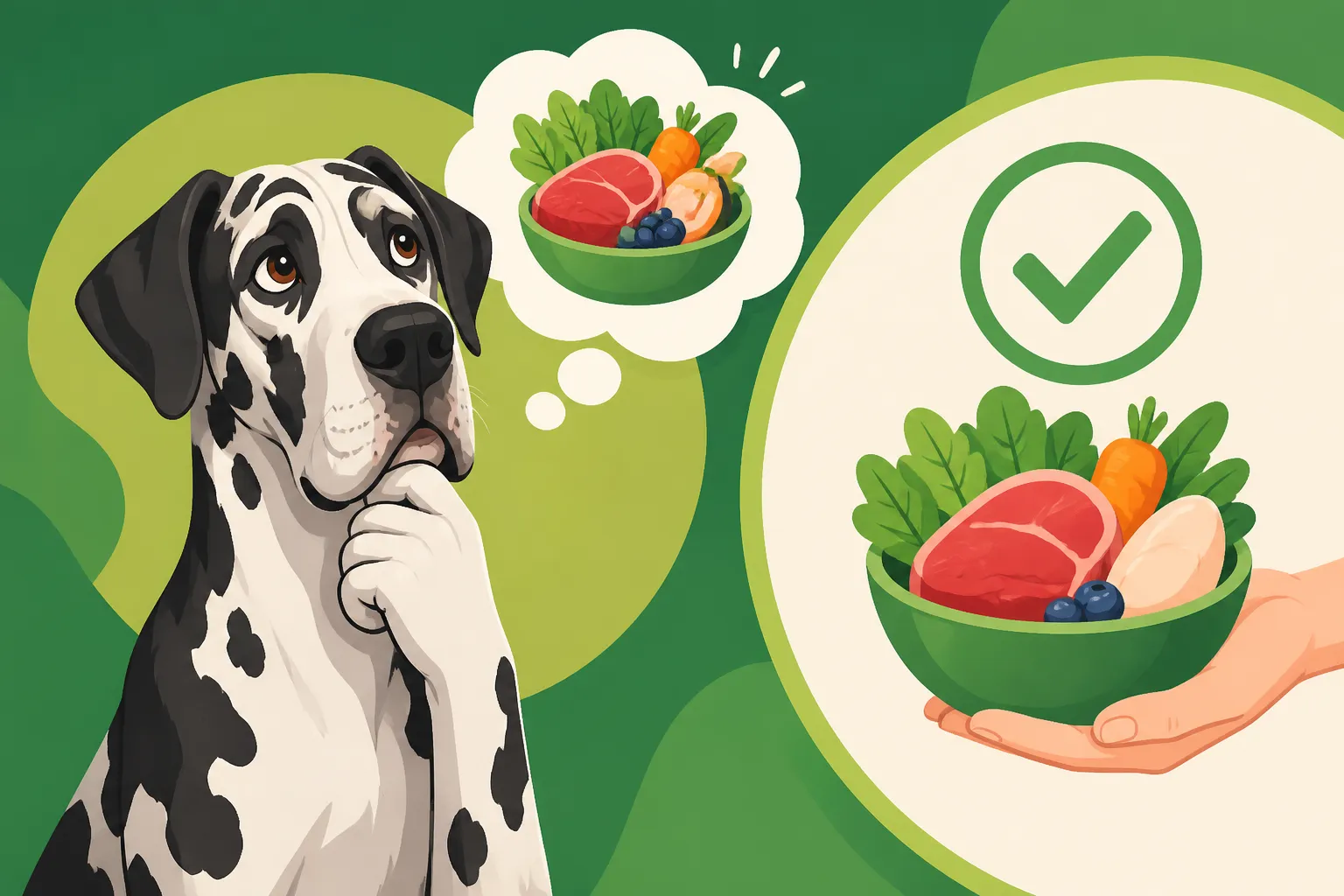
One of the most popular and practical ways to introduce fresh nutrition to your Great Dane is by supplementing a high-quality kibble with human-grade fresh ingredients. This allows you to leverage the convenience and nutritional completeness of a well-formulated large-breed kibble while adding variety, moisture, and beneficial nutrients from fresh foods.
Here's how to approach it carefully:
- Choose a High-Quality Kibble Base: Start with a kibble specifically designed for large or giant breeds, ensuring it meets the stringent nutritional requirements for your Dane's age and activity level. This is critical because it forms the backbone of their diet, providing essential vitamins and minerals.
- Select Appropriate Fresh Additions: Cooked, plain meats like chicken, turkey, or lean beef are excellent sources of protein. Steamed or raw vegetables such as carrots, green beans, pumpkin, or leafy greens can add fiber and antioxidants. A small amount of plain yogurt or a cooked egg can also be beneficial.
- Portion Control is Key: Remember that these are supplements, not the main meal. Start with small amounts, gradually increasing as your Dane adjusts. A common guideline is to replace about 10-20% of their kibble calories with fresh food. For a Great Dane, even 10% can be a significant addition.
- Beware of Nutritional Imbalances: This is the most crucial caveat. Simply adding a lot of meat or vegetables without reducing kibble can lead to overfeeding, and more importantly, can throw off the delicate balance of nutrients provided by the kibble. For puppies, it’s absolutely vital to avoid altering the Calcium and Phosphorus in a Great Dane Puppy Bowl ratio, as this can lead to serious developmental problems. If you're going to significantly supplement, consulting with a veterinary nutritionist is highly recommended to ensure you're not inadvertently creating deficiencies or excesses. This also helps you ensure you're providing enough Treats Sized for a Great Dane that are still healthy and beneficial.
This hybrid approach allows you to enhance your Dane's meals, provide exciting flavors and textures, and increase moisture intake, all while managing costs and storage more effectively than a full fresh diet.
Home-Cooked Meals (with caution)
The idea of cooking all your Great Dane's meals from scratch can be very appealing. You have complete control over ingredients, quality, and freshness. However, this path comes with its own set of substantial challenges, especially for a giant breed.
- Immense Time Commitment: As discussed earlier, Cooking for a Great Dane and the Volume Problem is real. Preparing several pounds of food daily, or batch cooking for a week, requires significant kitchen time, planning, and effort. This isn't just chopping a few veggies; it's managing large quantities of meat, grains, and supplements.
- Ensuring Nutritional Completeness: This is the biggest challenge and the most common pitfall for well-meaning home cooks. It is incredibly difficult to formulate a complete and balanced diet for a dog, let alone a giant breed with specific requirements, without expert guidance. Generic online recipes are often not nutritionally balanced long-term and can lead to serious deficiencies (or excesses) in vitamins, minerals, or macronutrients. For example, simply feeding cooked chicken and rice will not provide all the necessary nutrients your Great Dane needs. It’s far more complex than that.
- Veterinary Nutritionist Guidance is Essential: If you are serious about home-cooking for your Great Dane, the only safe and responsible way to do it is with a recipe formulated by a board-certified veterinary nutritionist. They can create a customized plan based on your dog's specific needs, incorporating all necessary ingredients and supplements to ensure a balanced diet. This personalized approach considers factors like age, activity, health conditions, and even potential allergies or sensitivities. They can also help you understand how to Adjusting Food After a Great Dane Is Neutered if that is a factor.
Without professional guidance, home-cooked diets, while made with love, can inadvertently cause more harm than good over time. Nutritional imbalances can manifest as subtle health issues initially, becoming serious problems down the line. It's a commitment that requires both time and a financial investment in expert advice.
Ultimately, while the allure of fresh food for our Great Danes is strong, the practicalities demand a realistic assessment. Many commercially prepared fresh food companies can technically serve a Great Dane, but the sheer volume required means substantial costs and significant logistical challenges around storage and delivery. For most owners, a hybrid approach of supplementing high-quality kibble with fresh, human-grade ingredients, or a carefully veterinarian-nutritionist-guided home-cooked diet, offers a more sustainable and equally beneficial path to providing optimal fresh nutrition for our beloved giants.
Disclaimer
This article is for general informational purposes only and does not constitute professional advice. Laws, prices and regulations vary by location and change over time. Consult a qualified professional for guidance on your specific situation.