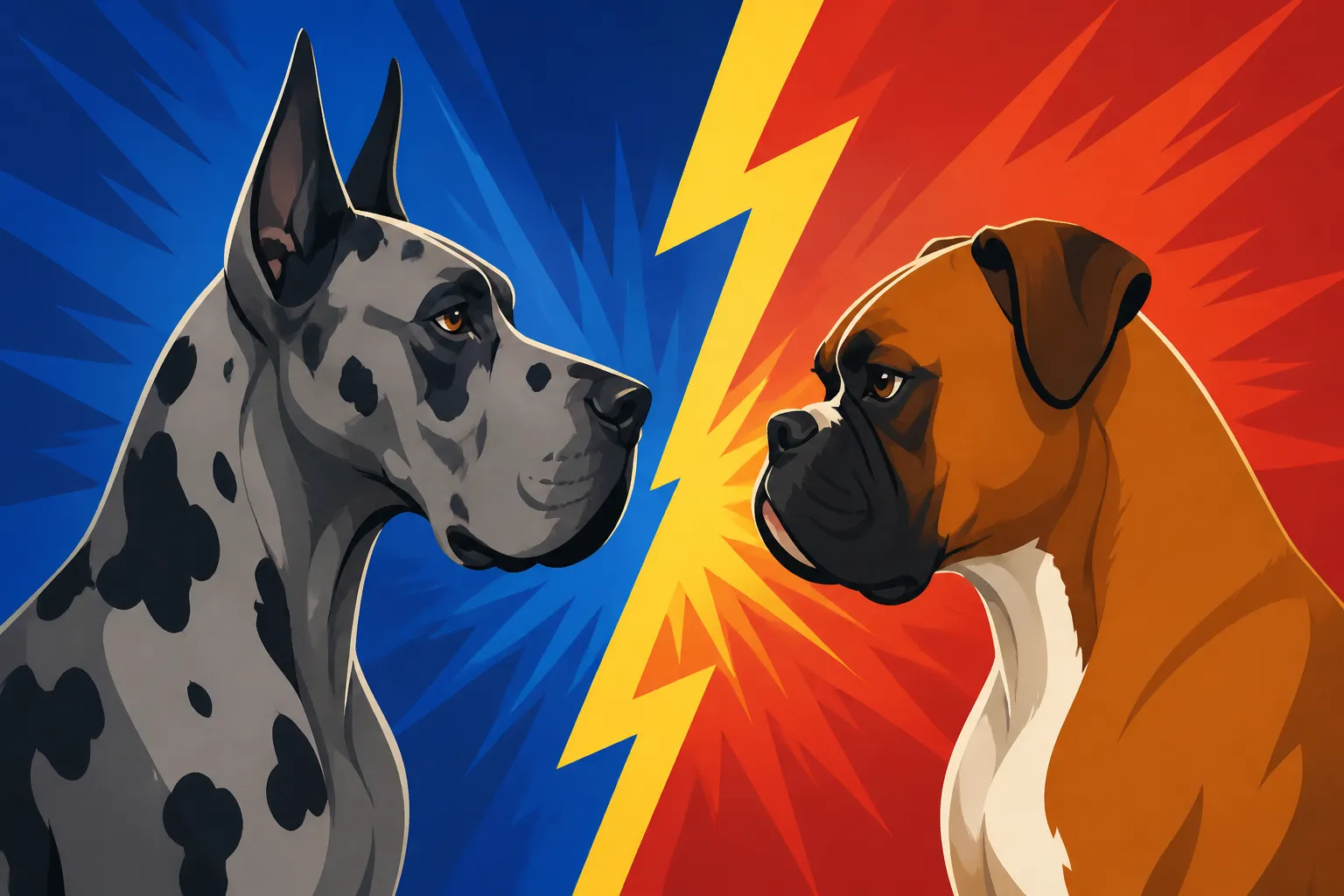
The Great Dane Against the Boxer in Type
A Great Dane and a Boxer may both be tall, powerful dogs with a confident presence, but they are built and bred in noticeably different ways. If you are comparing their “type” for breed identification, show-ring structure, or everyday life, this guide explains the differences in body, head, movement, and temperament—and why neither breed is simply a smaller or larger version of the other.
What “type” means in a Great Dane and Boxer
Breed type is more than size
In dogs, “type” describes the combination of traits that makes a breed recognizable and suited to its original purpose. It includes proportions, bone, head shape, movement, coat, and characteristic temperament. A dog can be large, muscular, and short-coated without having Great Dane type; the same is true of a Boxer.
Great Danes and Boxers are both associated with strength and confidence, but their outlines tell different stories. The Great Dane is a giant, long-legged dog whose presence comes from height, balance, and a powerful but relatively refined frame. The Boxer is a medium-to-large, compactly muscular dog whose outline looks more tightly packed and athletic.
“Bigger” does not automatically mean “more powerful” in every practical sense. A Boxer’s sturdy, close-coupled build gives it a different kind of strength and agility, while the Great Dane’s height and reach create a very different impression. Comparing them by weight alone misses much of what breed type is about.
Their original jobs shaped their outlines
Great Danes developed from large European dogs associated with hunting and guarding. Their traditional work called for a combination of size, strength, speed, and the ability to move with purpose. In the ring, a well-built Dane should look substantial without appearing clumsy, and its movement should be balanced rather than lumbering.
The Boxer’s background is distinct. The breed developed in Germany from working dogs, with ancestry connected to the Bullenbeisser. Boxers were valued for athleticism, alertness, and versatility. That history is reflected in a dog that looks muscular and ready to move, with a broad head, a short muzzle, and a compact, square outline.
Breed history helps explain why the two dogs can share a bold expression yet look so different. The Dane’s silhouette emphasizes height and length of leg. The Boxer’s emphasizes a powerful chest, strong limbs, and a close, athletic build. For more background, see The Great Dane the Show Ring Is Looking For and The Great Dane Against the Mastiff.
Great Dane and Boxer structure compared
Body proportions, bone, and overall silhouette
A Great Dane’s size is its most obvious distinction, but sound structure matters more than height by itself. The dog should have enough bone and depth to support its frame, yet remain balanced and capable of moving freely. A Dane that is excessively heavy, weak in the topline, or awkward in motion does not become better typed just because it is huge.
A Boxer is smaller in comparison, but it should not look slight or delicate. Its body is muscular and compact, with a strong chest and a firm outline. Boxers are generally square in profile: their height and body length are close to balanced. The Great Dane is also often described as nearly square, though individual proportions and sex can affect the outline. The useful distinction is not that one breed is always square and the other always long; it is the overall combination of scale, leg length, substance, and balance.
| Feature | Great Dane | Boxer |
|---|---|---|
| Overall impression | Giant, tall, balanced, and powerful | Compact, muscular, athletic, and sturdy |
| Frame | Long-legged with substantial bone | Strongly built with a close, square outline |
| Head | Long and relatively narrow, with a deep muzzle | Broad and expressive, with a shorter muzzle |
| Muzzle and jaw | More extended muzzle and a comparatively even profile | Short muzzle and characteristic undershot jaw |
| Movement | Balanced, ground-covering stride | Athletic, energetic movement with strong drive |
| Coat | Short and smooth | Short and smooth |
These descriptions are general, not a checklist for judging a dog from one glance. A puppy’s proportions change as it grows, and poor condition, injury, or an individual’s family lines can make a dog look less typical. If you are assessing a particular dog, look at the whole animal in motion rather than deciding from one feature, such as a broad chest or a short coat.
The head is one of the clearest differences
The head is often where the contrast between a Great Dane and a Boxer becomes unmistakable. A Dane’s head is long and rectangular in appearance, with a substantial muzzle that is not as short or pushed in as the Boxer’s. Its expression should look alert and composed, not coarse or exaggerated.
A Boxer’s head is broad and distinctive, with a short, square muzzle and an undershot bite. The muzzle is not merely a cosmetic difference: its shape is part of the breed’s identity. Boxers are brachycephalic, meaning they have a shortened facial structure. That can affect breathing and heat tolerance, so owners should pay attention to noisy or labored breathing, especially during exercise or warm weather.
The head shapes can also affect daily care. Both breeds benefit from routine dental checks and gentle handling around the face, but the Boxer’s shorter muzzle can make heat management and strenuous activity more important considerations. For a closer look at the Dane’s characteristic outline, read The Great Dane Head the Standard Wants. For other breed features that can influence health and daily care, see Great Dane Eyelid and Eye Problems.
Movement, temperament, and daily life
How their movement reflects their build
A well-conditioned Great Dane should move with a long, balanced stride that uses its reach without appearing strained. Its height makes each step visually dramatic, but the goal is not a towering, stiff gait. Sound movement depends on coordination, muscle condition, and healthy joints as well as structure.
Boxers tend to look more springy and tightly athletic. Their body is designed for active movement, and their expression and posture often give them an energetic, engaged appearance. A Boxer that is very heavy or poorly conditioned may lose some of that athletic quality, just as an under-muscled or structurally unsound Dane may not move as freely as expected.
Neither breed should be judged only while standing. Watch the dog walk and trot, and notice whether it moves evenly, whether its back stays stable, and whether it seems comfortable. If a Great Dane begins limping or becomes reluctant to exercise, do not assume it is simply “being lazy”; A Great Dane That Limps Without an Injury explains why a change in movement deserves attention.
Similar confidence does not mean identical temperament
Both breeds can be affectionate and people-oriented, but breed tendencies are not guarantees. Great Danes are often described as gentle and sociable, yet their size makes early manners especially important. A Dane that leans, jumps, or barrels through a doorway can accidentally knock someone over even when it is friendly.
Boxers are commonly lively, playful, and enthusiastic. Their energy can be delightful, but it may feel like a lot in a household that expects a quiet dog from the beginning. Training, socialization, age, health, and the individual dog’s history all shape behavior. A calm adult Boxer may be easier to live with than a boisterous Dane puppy, while another Boxer may be the more exuberant dog in the household.
For either breed, reward-based training and predictable routines help turn enthusiasm into manageable habits. Teach polite greetings before a dog is strong enough to pull someone off balance, and practice settling on a mat or bed. With a Great Dane, the physical consequences of delayed training are amplified by size; The Manners a Great Dane Needs Before It Grows offers useful context for starting early.
Choosing between the breeds and caring for them
Match the dog to your household, not the silhouette
If you are drawn to the Great Dane because of its imposing height, also consider the practical space its body occupies. It needs room to turn, stretch out, and move through the home without constantly knocking into furniture. Its size can affect car travel, bedding, veterinary handling, and the ease of lifting or assisting it if it becomes ill.
A Boxer’s compactness does not make it a low-effort dog. It still needs exercise, training, social contact, and thoughtful heat management. Its shorter muzzle deserves particular attention during hot weather and vigorous activity. A fenced yard may be convenient for either breed, but it does not replace walks, training, or time spent with people.
Before deciding, consider your schedule, physical ability, budget, housing rules, and experience with large or energetic dogs. If you share your home with children or smaller pets, plan for supervised introductions and teach everyone how to give the dog space. Whether a Great Dane Suits Your House and Great Danes in Homes With Small Children can help you think through the Dane-specific side of that decision.
Set up for the dog’s actual size and needs
For a Great Dane, measure before buying. A bed that looks large in a store may be too short once the dog stretches out, and a crate must allow the dog to stand, turn, and lie down comfortably. Chewy can be one place to compare pet supplies, but check dimensions carefully rather than relying on labels such as “large” or “giant.” Different products use those terms inconsistently.
Boxer owners should also check measurements, especially for harnesses, beds, and crates. A compact dog can still have a deep chest and a muscular neck, so a generic fit may rub or restrict movement. If you are comparing options through Chewy or another retailer, measure the dog’s chest and body length and review the manufacturer’s sizing guidance.
For both breeds, invest in secure walking equipment and practice calm leash behavior before strength becomes a challenge. A Dane’s height can bring its nose to counters and tabletops; a Boxer’s athleticism can make excitement difficult to manage without training. Keep water available, maintain a healthy body condition, and talk with your veterinarian about age-appropriate exercise. For Danes in particular, Keeping a Great Dane Lean for Its Joints is a helpful reminder that extra weight is not harmless on a giant frame.
Look beyond breed labels when meeting an individual dog
If you are choosing a puppy, ask about health testing, temperament, and the parents’ behavior—not just color, size, or show potential. A reputable breeder should be willing to discuss the strengths and health considerations of their dogs and to explain what they are doing to support sound structure. The Health Testing a Great Dane Breeder Owes You offers a starting point for questions to ask about a Dane.
If you are considering an adult dog, ask how it behaves around visitors, children, other dogs, and routine handling. Watch it walk on a leash and settle after excitement. A dog’s daily habits often tell you more about the fit than a brief impression of its appearance. An adult dog may also make it easier to assess mature size and temperament than a young puppy whose personality and proportions are still developing.
The most useful comparison is not “Which breed is better?” but “Which individual dog fits my home and ability to meet its needs?” Great Danes and Boxers share strength and presence, but their bodies, exercise considerations, and everyday demands differ. A careful match can make the difference between admiring a breed from across the park and enjoying life together at home.
Disclaimer
This article is for general informational purposes only and does not constitute professional advice. Laws, prices and regulations vary by location and change over time. Consult a qualified professional for guidance on your specific situation.